
Navadha Bhakti refers to the nine sacred forms of devotion in the Sanatan or Hindu spiritual tradition. These nine pathways offer a comprehensive approach to spiritual practice that goes far beyond temple visits or rituals. For children and adults alike, understanding the meaning of Navadha Bhakti provides practical
understanding the nine forms of devotion

The February wind carried a chill through the streets of Devbhoomi as twelve-year-old Tarkik walked home from school, his feet dragging with each step. The majestic Himalayas, usually a source of wonder, seemed to loom oppressively against the grey sky. His school bag felt heavier than usual, but not as heavy as the weight in his chest.
The image wouldn’t leave his mind—Arjun, his best friend since kindergarten, sobbing uncontrollably at his father’s funeral that morning. Uncle Prasad had been the kindest man Tarkik knew, always ready with a smile and a cricket ball for the neighborhood children. A sudden heart attack at forty-two. No warning. No logic. No fairness.
As Tarkik pushed open the creaky wooden gate of his home, the familiar scent of sandalwood incense drifted toward him. Through the window, he could see his grandmother in the prayer room, her silver hair gleaming in the lamplight as she arranged brass vessels with methodical care.
“Dadi,” Tarkik called out, dropping his bag with a thud that echoed his mood.
His grandmother turned, her weathered face breaking into a smile that faltered when she saw his expression. “Arrey, Tarkik beta, what troubles you? Come, sit with me.”
Tarkik entered the prayer room, its walls adorned with pictures of various deities and saints. The small space always felt larger than it was, as if it contained something beyond its physical dimensions. Today, nine brass diyas sat unlit before a garlanded portrait of Lord Ram and an elderly tribal woman.
“Dadi,” Tarkik’s voice cracked, surprising them both. “If there is a God, why does He let good people suffer? Why did Arjun’s father have to die?”
The question hung in the air like incense smoke. Dadi’s hands stilled on the cotton wicks she was preparing. When she looked at her grandson, her eyes held the weight of eighty-six years of living—years that had seen partition, loss, joy, and wisdom earned through experience.
“Ah,” she said softly, settling onto the floor with a grace that belied her age. “You ask the question that every thinking person must ask. Come, sit properly. This is not a question for quick answers.”
Tarkik sat cross-legged, his school uniform rumpling. “Everyone at the funeral kept saying it was God’s will. But what kind of God wills a good man to leave his family? It doesn’t make logical sense, Dadi.”
His grandmother reached for the matchbox, her movements deliberate. “Today is Shabari Jayanti, the day we remember a woman who waited her entire life for a meeting that logic said would never come. Perhaps her story, and the wisdom Lord Ram shared with her, can help us understand suffering differently.”
Shabari Jayanti, is observed annually on the Krishna Paksha Saptami of Phalguna
“Another story?” Tarkik’s tone carried a hint of frustration. “Dadi, I need real answers, not mythology.”
“Beta,” Dadi’s voice remained gentle but firm, “sometimes the deepest truths can only be approached through stories. Logic alone is like trying to capture the ocean in a cup—useful, but limited. Will you trust me for one night? Let us light these nine diyas together, and with each flame, I’ll share one of the nine forms of bhakti that Lord Ram taught Shabari. By dawn, you may find your answer.”
Something in his grandmother’s tone made Tarkik nod. Perhaps it was the way she said ‘by dawn’—not as a promise of easy answers, but as an invitation to a journey.

The Story of Shabari: A Testament to Pure Devotion
“But first,” Dadi said, settling more comfortably, “you must understand why these nine forms were taught. Let me tell you about Shabari herself.”
Tarkik nodded eagerly, his logical mind already curious about this concept that seemed to hold such importance for his grandmother.
“Let me tell you then,” Dadi began, her voice taking on a melodious quality that always accompanied her storytelling. “Long ago, in the ancient forests of Dandaka, lived an elderly woman named Shabari. Though she came from a humble tribal background, considered ‘lowly’ by society, her heart was filled with pure devotion for Lord Ram.”
“For years, she had waited in her small ashram, maintaining it with meticulous care. Each morning, she would gather the sweetest berries from the forest, tasting each one to ensure only the finest would be offered to her Lord when he arrived.”
“Waited for years?” Tarkik interrupted, his practical mind calculating. “How could she be so sure Lord Ram would come? Wasn’t that illogical, Dadi?”
Dadi’s eyes twinkled with amusement. “That, my dear, is the first lesson of bhakti—faith that transcends logic. Her guru had prophesied Ram’s arrival, and Shabari’s faith never wavered, not for a single day during her long wait.”
“Then what happened?” Tarkik asked, now fully engaged in the tale.
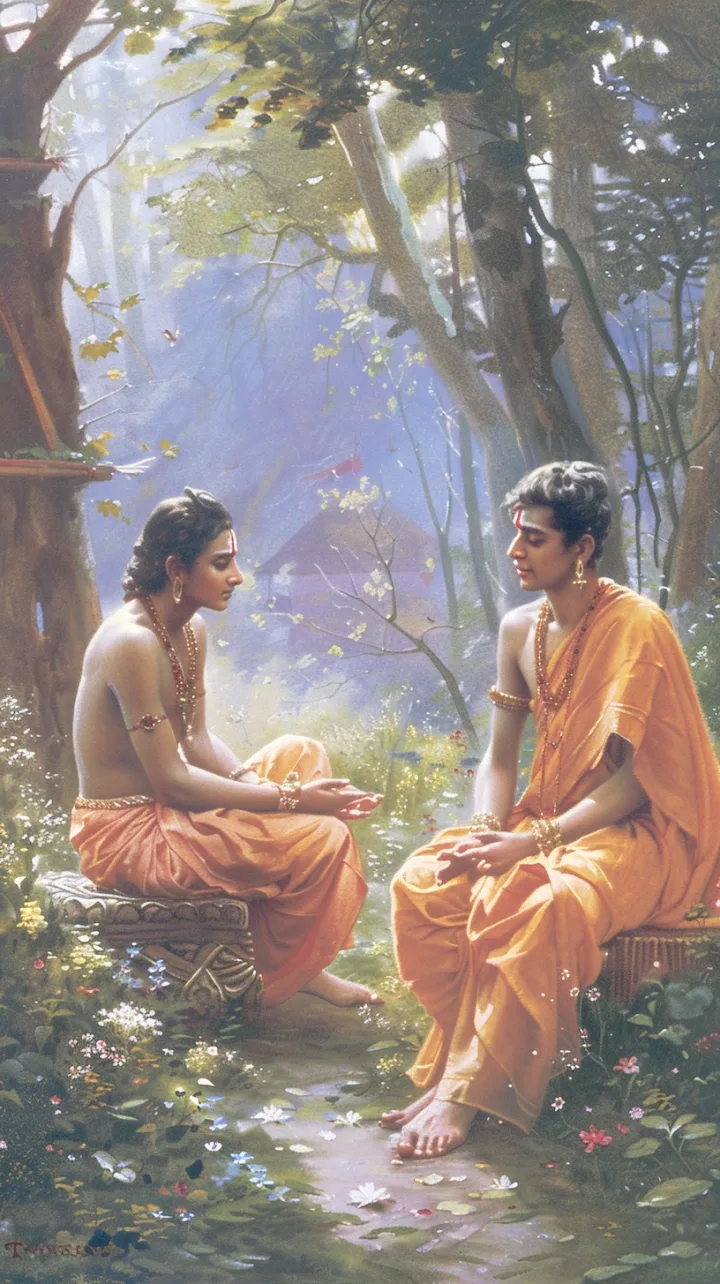
“One glorious day,” Dadi continued, her voice rising with excitement, “Lord Ram and his brother Lakshman did arrive at her humble dwelling! Imagine her joy, Tarkik! The divine being she had waited for all those years stood before her, his compassionate eyes taking in her simple abode.”
Tarkik could almost visualize the scene—the divine prince with his bow and his loyal brother, standing before the elderly tribal woman whose face would have lit up with indescribable joy.
“Shabari immediately offered Ram the berries she had collected, the ones she had personally tasted to ensure their sweetness,” Dadi said, her hands mimicking the offering gesture. “Now, in those times, offering food that had been tasted was considered impure. But do you know what Ram did?”
Tarkik shook his head, engrossed in the story.
“He accepted each berry with genuine appreciation, declaring they were the sweetest he had ever tasted!” Dadi exclaimed. “This teaches us that true bhakti breaks through social barriers and conventions. The divine sees the heart’s purity, not external factors.”
“But why did she have such faith? What made her wait all those years?” Tarkik pressed, his analytical mind seeking the logic beneath the devotion.
“Her guru, before taking samadhi, had told her that Lord Ram would come to her humble dwelling during his exile. For Shabari, her guru’s word was truth itself. Every day of waiting was an act of devotion, every berry collected was a prayer, every moment of preparation was meditation.”
Dadi paused, letting the story sink in. “And when Lord Ram was ready to leave, Shabari made a request that would echo through the ages. She asked him to teach her the path of bhakti before she left her mortal body.”
“And that’s when he taught her these nine forms?” Tarkik asked, glancing at the unlit diyas.
“Yes,” Dadi nodded. “The same nine forms I will share with you tonight. Lord Ram saw that Shabari had already been practicing bhakti her entire life. His teaching simply gave names to what she had lived. Sometimes, beta, we need words to understand what our hearts already know.”
She picked up the matchbox, its weight familiar in her weathered hands. “Shall we begin? Like Shabari, perhaps you’ll discover you already know more about devotion than you think.”