
Story continues from
14: The Number Ram Was Written In
The biology teacher was explaining cell division.
Tarkik was thinking about Jacob.
He had found the reference three nights ago, at half past eleven, when he should have been asleep. He had typed “14 in other religions” into the search bar almost as a joke — the kind of late-night rabbit hole he knew he would regret in the morning. But then the results had come back, and one of them had stopped him so completely that he had sat up straight in bed and read it three times.
Jacob, in the Book of Genesis, had loved a woman named Rachel. Her father agreed to the marriage on one condition: Jacob must work for him for seven years first. Jacob worked the seven years. The father then gave him the wrong daughter. So Jacob worked seven more years. Fourteen years in total — stripped of the life he was meant to live, doing the hardest work of his life in someone else’s fields — before he could finally arrive at the future that was always his.
Tarkik had stared at his phone in the dark of his Delhi bedroom.

Jacob had worked fourteen years to reach the life he was born for.
Ram had walked fourteen years through forests and battles and loss — separated not from Sita for the full duration, he was careful to remember, but from everything else that defined him. His throne, his city, his father, his rightful place in the world. Sita had been with him through most of it, until Ravan took her in the final stretch — and then Ram had crossed an ocean to bring her back, because a man who has gone through thirteen years of everything is not going to stop at the thirteenth.
Same number. Same structure. Same arc — a long, unsparing, complete journey before the arrival. And between ancient India and ancient Israel, there had been no contact, no shared texts, no common language.
He had not slept well after that.
He had not slept well after that.
Over the following two days, he had found more.
Ancient Egypt: the god Osiris, killed by his brother Seth, whose body was torn into fourteen pieces and scattered across the land. His devoted wife Isis searched every corner of Egypt, found each piece, and restored him — and Osiris became the eternal king of the afterworld. A divine king, broken into fourteen parts, reassembled by love, restored to sovereignty.
Christianity: the Stations of the Cross, the fourteen moments of suffering that Jesus walked before his resurrection. Fourteen steps of the hardest possible human experience before the arrival at something beyond it.
Jain philosophy: the fourteen Gunasthanas — fourteen progressive stages of soul purification that a being must climb, in order, before reaching moksha. Not thirteen. Not fifteen. Fourteen rungs on the ladder, and then liberation.

Each time Tarkik found a new one, he felt the same thing he had felt on the Haridwar terrace — that particular sensation of a pattern becoming too precise to dismiss.
He called Dadi on a Wednesday evening.
“I found more,” he said, without saying hello.
“I know,” she said, which was the most Dadi answer possible.
“Jacob worked fourteen years before he could live the life he was born for — same structure as Ram’s vanvas, same number, different continent, different faith. Osiris was torn into fourteen pieces and had to be made whole before he could be king. The Stations of the Cross are fourteen. The Jain Gunasthanas are fourteen.” He paused. “These civilisations had no contact with each other, Dadi. How does the same number appear in all of them, doing the same thing in all of them?”
There was a brief silence on the line — not the silence of someone thinking, but the silence of someone deciding how much of a door to open at once.

“Come to Haridwar this weekend,” she said. “This is not a phone conversation.”
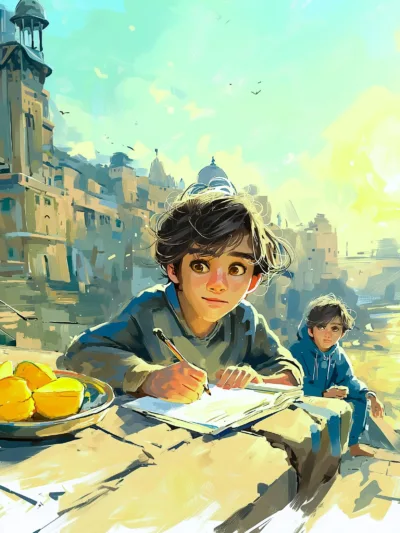
He arrived on a Saturday morning. By evening, they were back on the terrace.
The Ganga moved below, catching the last of the daylight. The March air was warm now, properly warm, the winter finally gone. Somewhere downriver, the sound of an aarti was beginning — bells and conch shells carried on the breeze in fragments.
“You found four traditions,” Dadi said. “All with fourteen. All apparently independent.” She looked at him. “What are the possible explanations?”
Tarkik had been thinking about this on the train. “Three,” he said. “One: they all learned it from the same source — one tradition taught the others. Two: they all came from an even older common ancestor that we don’t have records of, and they each inherited the number from that root. Three: they all discovered it independently, because they were all observing the same thing.”
Dadi looked at him with an expression he recognised — the one that meant he had done well and she was not going to say so directly.
“Good,” she said. “Now let us be honest about what the evidence actually supports for each.”
She shifted slightly on the bench, pulling her dupatta closer as the evening breeze picked up off the river.
“The first route — that one tradition taught the others — has some genuine evidence, but only in specific places.”
“Like where?” Tarkik asked.
“There was a kingdom called Mitanni, in ancient Syria, around 1500 BCE. They signed a peace treaty — and in that treaty, they invoked Vedic gods as witnesses. Mitra, Varuna, Indra — by name, in West Asia, a thousand years before any formal contact with India that Western scholarship acknowledges.” She let that land for a moment. “That is not a guess. That is a document.”
“So Vedic ideas did travel westward.”
“Some did. But —” she tilted her head slightly, “— does that explain Jacob? Does it explain Osiris? For those, we have no transmission chain. No document, no treaty, no shared text. We cannot honestly claim that route for them.”
“So the first route only works partially,” Tarkik said.
“Partially. The second route — a common ancestor — is the mainstream scholarly position for the Indo-European family. Sanskrit, Greek, Latin, Persian, the Germanic languages — all descended from a single ancient tongue. So some of the parallels between Vedic and Greek thought, for instance, may reflect a shared root rather than direct teaching. India borrowing from elsewhere, or elsewhere borrowing from India, but both drawing from something older.”
“And the third route?”
Dadi was quiet for a moment. Below them, the aarti bells were growing louder, then softer, carried on the shifting breeze.
“The third route,” she said, “is the most powerful. And it is the one that Sanatan Dharma’s own self-understanding actually supports.” She looked at him. “What do all four traditions have in common, Tarkik? Not their gods, not their languages, not their geography. What did all of them share?”
He thought about it. Jacob’s ancient Israel. Osiris’s Egypt. Jesus’s Palestine. The Jain sages of India. Centuries apart, continents apart.
“They all looked at the same sky,” he said.
“They all looked at the same sky,” Dadi confirmed. “And the sky told all of them the same thing. The moon takes fourteen nights to go from darkness to fullness. Every month, without exception, for four billion years. Every civilisation that watched the sky carefully — and every ancient civilisation did, because the sky was their calendar, their clock, their compass — found the same number. They did not copy each other. They all simply looked up.”
Tarkik was quiet, working through it.
“So fourteen is not India’s invention,” he said slowly. “It’s not anyone’s invention. It’s just — what the moon does.”
“Exactly. And here is where Sanatan Dharma’s position becomes genuinely extraordinary — not because of what it claims, but because of what it does not claim.” Dadi’s voice was precise now, the way it got when she was saying something she had thought about carefully. “Sanatan Dharma does not say it invented these truths. It says it heard them. The Vedas are described as eternal — not created by humans, but received by rishis who had made themselves quiet enough to listen. Sanatan does not claim to have discovered dharma. It claims that dharma always existed, and that the rishis were the ones who wrote it down most completely.”
“That’s a very different claim,” Tarkik said.
“It is a far stronger one. Because if you claim you invented something, someone can challenge your priority. But if you say — this is a natural law, like gravity, and we observed it most carefully and recorded it most completely — that is not a claim that can be stolen or disputed. It is simply a description of what happened.”
The aarti bells had stopped. The river moved on in its own quiet way.
“But then why,” Tarkik said, “does Sanatan feel so much more complete than the others? Jacob’s fourteen years is one story, buried in Genesis. The Stations of the Cross are fourteen but nobody explains why. Osiris in fourteen pieces — the Egyptians preserved the myth but not the reasoning behind it. And here, in the Ramayana alone, fourteen appears in the weapons, the knowledge, the commanders, the exile, the flaws of kings, the lokas, the battle, the bridge—”
“Because,” Dadi said quietly, “other traditions found pages. Sanatan found the library.”
Tarkik looked at her.

“Imagine,” she said, “that someone wrote a great book about the laws of the universe, and then scattered its pages across the world. Different civilisations found different pages. The Egyptians found a page about the divine king who must be broken and restored. The Hebrews found a page about the man who must work the full fourteen before he can arrive. The Christians found a page about the fourteen stations of suffering before resurrection. The Jains found a page about the fourteen stages of the soul’s journey.” She paused. “The rishis of Bharat found the whole book. And they kept it open.”
The silence that followed felt different from ordinary silence — the kind that comes after something has been said that cannot be unsaid.
“That’s why the Ramayana has fourteen everywhere,” Tarkik said, almost to himself. “Because whoever wrote it understood the whole system — not just one instance of the number, but the underlying law that generates the number. And they encoded that law into every layer of the story.”
“Every layer,” Dadi agreed. “The exile. The weapons. The knowledge. The battle. The bridge. The lokas. Each one is the same truth, written in a different language. A story for those who need story. A number for those who need mathematics. An astronomical observation for those who need science. All saying the same thing.”
Tarkik looked up at the sky. The moon was visible now — not a crescent anymore, but a half-moon, the seventh or eighth tithi, growing steadily toward its fullness. Six or seven more nights.
He thought about Ram in the forest, year one of fourteen — Sita beside him, the kingdom behind him, everything still ahead of him. He thought about Jacob in the fields, year one of fourteen. He thought about Osiris in fourteen pieces, waiting to be made whole. He thought about the Jain soul on the first Gunasthana, thirteen rungs still to climb.
He thought about the moon, on the first tithi after Amavasya — the thinnest possible sliver, barely there, with fourteen nights of work ahead before it could become what it was always going to be.
“It’s a promise,” he said quietly.
Dadi looked at him.
“Fourteen is the moon’s promise,” Tarkik said. “It doesn’t matter which tradition found it, or how, or when. The promise is the same in all of them. Keep going. Go through all of it, don’t skip anything, don’t stop at the thirteenth — because the fifteenth night is always Purnima.” He paused. “Ram kept the promise. Jacob kept it. The moon keeps it every single month.” He looked at her. “That’s what fourteen means.”
Dadi was quiet for a long moment.
Then she simply nodded — the small, precise nod of someone who has been waiting a long time for another person to arrive at a particular place, and is glad they finally got there on their own.
“Go to sleep,” she said, standing slowly. “You have school on Monday.”
She went inside.

Tarkik stayed on the terrace. The half-moon hung above the Ganga, exactly halfway through its promise.
Six more nights to go.