
..story continues from The Day the Universe Did Not Need a Muhurta
Tarkik woke before the alarm.
This happened sometimes when his mind hadn’t finished a thought from the night before. He lay still for a moment in the dark of Dadi’s spare room, listening to the Ganga. Even at this hour — the sky outside still deep blue, the first pale line of dawn just beginning at the edge of the hills — the river was there. Constant. Neither hurrying nor waiting.
He got up.
Akshay was already on the terrace.
This was surprising. Akshay, in Delhi, required three alarms and a reminder about breakfast before he became functional. But here he was, sitting on the low stone bench with his elbows on his knees, looking at the river in the early light.
“Couldn’t sleep,” Akshay said, without turning around.
“Me neither.” Tarkik sat beside him.

Below them the Ganga caught the first faint light — silver rather than gold at this hour, moving in long quiet sheets. The ghats were empty. A single lamp burned somewhere downstream, its reflection rippling in the current. The air smelled of water and woodsmoke and something floral that Tarkik could never name but associated entirely with early mornings in Haridwar.
Neither of them spoke for a while. It was the particular silence of two people thinking about the same thing without having agreed to.
Then Akshay said: “The lamp that burns brighter the more the wind blows.” He was still looking at the river. “I keep thinking about that.”
Tarkik nodded. He had been thinking about it too.
“Most things diminish,” Akshay said. “You use them, they reduce. Money. Food. Time.” He paused. “But some things work the other way. The more you use them, the more there is.”
“Knowledge,” Tarkik said.
“Devotion,” said Dadi.
They both turned. She was standing in the doorway with two steel tumblers of chai, entirely unsurprised to find them both awake. She handed them the tumblers and sat in her chair, which someone — probably she — had already moved to the terrace.
“You said you would tell us the large question,” Tarkik said.
“I said I would tell you about a pot,” she replied, “and a day that began an age.” She wrapped both hands around her own tumbler. “They are the same story.”
— — —

She did not begin with the pot.
She began, as she often did, somewhere that seemed unrelated.
“What age of the world do we live in?”
Tarkik answered automatically. “Kali Yuga. The fourth age. The iron age.”
“And before Kali Yuga?”
“Dvapara Yuga. Before that, Treta. Before that, Satya — the golden age, when dharma was complete.”
“Good.” Dadi looked at the river. “Treta Yuga is the age in which both Parashurama and Rama walked the earth. It is the age of great avatars, great battles, great devotion.” She paused. “It began on Akshaya Tritiya.”
Akshay looked up. “This day?”
“This day. Every year on Akshaya Tritiya, the tradition marks not just a date in the calendar but the anniversary of the beginning of an entire cosmic age.” She let that land for a moment. “Think about what that means. The same principle — of abundant beginning, of replenishment that arrives before the emptying is complete — operates not just at the scale of a harvest, or a day, or a year. It operates at the scale of a yuga. Millions of years.”
Tarkik was very still.
“The festival is a fractal,” he said slowly.
Dadi tilted her head.
“The same pattern at every scale,” he said. “The crescent moon growing to Purnima — that’s fourteen days. The Kharif stores replenished by the Rabi harvest — that’s six months. A cosmic age beginning on this day — that’s millions of years. Same truth. Different scale.” He looked at her. “The rishis didn’t just observe the pattern in one place. They found it everywhere and encoded it into the same day.”
“Every Sanatan festival,” Dadi said, “is a metaphor. But never for only one thing. The same truth is always written in multiple languages simultaneously — the language of the sky, the harvest, the myth, the mathematics. You only need to find one door. But once inside, all the others are waiting.”
— — —
“Now,” she said, “the pot.”
She set down her tumbler.
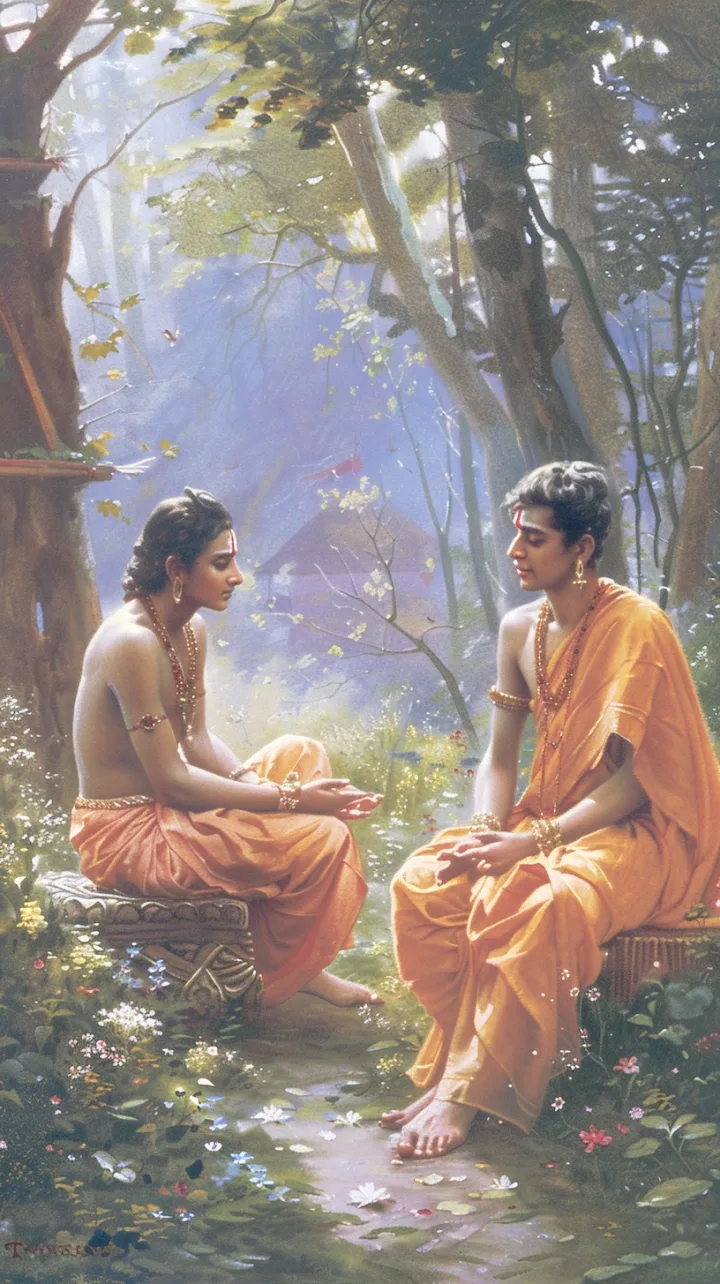
“During the Pandavas’ exile in the forest, their greatest difficulty was not hunger or hardship. It was hospitality. In our tradition, a guest must be fed — this is not a courtesy, it is dharma. But in the forest, with nothing, how do you feed a hundred visiting sages?”
“Yudhishthira prayed to Surya — the Sun God,” Tarkik said. He knew this story.
“He prayed,” Dadi confirmed, “and Surya appeared and gave him the Akshaya Patra. A divine vessel. It would produce food without end — enough to feed everyone who came — until Draupadi herself had eaten her meal each day. After that, it would be empty until the next morning.”
“So it resets every day,” Akshay said.
“Every day. Like the harvest. Like the moon. Replenishment built into the rhythm.”
Akshay frowned slightly. “But if it empties after Draupadi eats — what happens if someone comes after?”
Dadi smiled. “Duryodhana asked the same question. He knew about the pot. So he sent the sage Durvasa — famously short-tempered, famously impossible to satisfy — with hundreds of disciples, timed to arrive precisely after Draupadi had eaten her meal.”
“So the pot was empty,” Tarkik said.
“The pot was empty. Hundreds of hungry sages were coming. And the curse of Durvasa, if his hospitality was refused, could destroy everything the Pandavas had.”
The river moved below them in the early light. Somewhere a bird had begun calling — a single repeating note, unhurried.
“Draupadi prayed to Krishna,” Dadi continued. “He came. He looked into the empty pot. And in its corner — stuck to the edge — he found one single grain of rice and a fragment of vegetable. He ate it.” She paused. “And in that moment, the entire universe felt satiated. Durvasa and his hundreds of disciples, bathing in the river nearby, suddenly felt completely full. They could not eat. They left without incident.”
Silence.
Then Akshay said: “One grain.”
“One grain.”
“That’s not… logical.”
“No,” Dadi agreed. “It is theological. The divine is not fed by quantity. It is fed by the devotion behind the offering. Draupadi did not have a full pot — she had a clean pot, an empty pot, a pot that had been used fully in the service of dharma. That single grain was the residue of a day of complete giving. And that—” she looked at them both, “— was enough to satisfy the universe.”
Tarkik put his pen down. He had been writing continuously for several minutes without noticing.
“The Akshaya Patra isn’t magic,” he said. “It’s the same metaphor again. The vessel that replenishes before it runs out — just like the harvest, just like the moon. Surya gives it because Surya is the force behind the harvest, behind the exaltation today, behind the gold.” He stopped. “It’s all one system.”
“And the single grain,” Dadi said quietly, “is the tradition’s answer to a question people have asked in every age: is what I have enough? Is what I can give enough?” She looked at the river. “The answer, in every language this festival speaks, is the same. Give from what you have. Give truly. The universe will not let the right offering go to waste.”
— — —
The sun had fully risen now. The Ganga had turned from silver to gold, the ghats beginning to fill with the morning’s first pilgrims. The smell of incense had joined the woodsmoke and the river.
Dadi went inside to make breakfast.
Tarkik and Akshay sat in the warm morning light without speaking. It was a different silence from the one before — not the silence of unfinished thoughts but the silence of thoughts that had arrived somewhere and were resting.
Akshay looked at Tarkik’s notebook. Several pages were filled now — not neat notes, but the sprawling, connected kind of writing Tarkik did when he was thinking fast, arrows linking ideas, words circled, questions in the margins.
“You’ve been waiting to start that for a while,” Akshay said.
It wasn’t a question. Akshay had known him since Class 6.
Tarkik looked at the pages. “Since October,” he said. “I kept thinking I’d start after exams. Then, after the holidays. Then, when I had a proper plan.”
“And?”
“And then you showed up at my door at six forty-five in the morning, and I didn’t have time to think about it.” He looked at Akshay. “I just… started.”
Akshay smiled — the small one, not the performing one. “The day that needs no permission.”
Tarkik looked down at the notebook. Then up at the river. The Ganga moved as it always had — not waiting, not hurrying, simply doing the one thing it was made to do, without pausing to question whether the timing was right.
He thought about the crescent moon from the night before — third tithi, the thinnest bright curve, already on its way to Purnima without ceremony or announcement.
He thought about the farmers of Vaishakha, whose new crop arrived not after the old stores ran out but just before — the gap never opening, the abundance never broken.
He thought about Draupadi’s single grain, and a universe that was satisfied by it.
He opened the notebook to a fresh page. At the top, he wrote:
Every festival is a door with many keys. You only need to find one. But once inside, all the others are waiting.

He looked at it for a moment. Then wrote underneath, smaller:
This is the first page. There is no better time to begin than a day that has already begun without you.
Dadi appeared in the doorway with parathas and a steel plate of sliced mango. She glanced at the notebook. Said nothing. Set the plate down between them.
Outside, Haridwar was fully awake now — bells from a nearby temple, the splash and murmur of the ghats, the smell of marigolds from a flower-seller somewhere below. The Ganga caught the full morning sun and threw it back at the sky.
Akshay picked up a piece of mango.
“You know,” he said, “my mum is going to ask what I learned on this trip.”
“What will you tell her?”
Akshay thought about it. “That I finally know why she buys gold. And that my name is not just a nice word.” He paused. “And that I came without a plan, and it turned out to be exactly the right thing.”
Tarkik smiled. “Swayam Siddha.”
“Self-proven,” Akshay said.
Below them, the Ganga moved on — full and unhurried, neither diminishing nor needing to prove it, doing what it had always done on every Akshaya Tritiya for longer than either of them could imagine. Replenishing before the emptying was complete. Arriving before the gap could open.
The lamp that burns brighter the more the wind blows.
— — —