
Nishkaam Karma: Previously: In the last two stories, Dadi explained the wheel of Samsara — every Jiva working its way through form after form, mineral to plant to animal to human — and what it carries between lives: character and desire, not memories. In The Rope and the River, she described karma as a law built from three threads: desire produces thought, thought produces action, and action comes back. Tarkik wrote his next question in his notebook before leaving Haridwar: if karma is a law — desire producing thought producing action — is there a way to act that creates no new karma at all?
Himshikhar Boarding School sat in the fold of two Himalayan ridges, high enough that the pine trees came right up to the eastern wall, and you could hear them at night when the wind moved through. In December, the air had a particular quality — clean and cold and faintly resinous, nothing like the warm amber mornings in Haridwar.
Tarkik found out about the visit on a Tuesday, which gave him exactly three days to think of something worth asking.
Not that he’d been short of questions. The notebook had accumulated six new ones since Haridwar, all circled, all connected. But Dadi would be here for one afternoon — she was attending an astronomy symposium in Rishikesh and had arranged to stop at Himshikhar on the way back — and he did not want to waste it.
He had settled on one question by Friday morning: Is there a way to act without creating karma at all?
Akshay found out about the visit on Friday afternoon, which gave him exactly two hours.
“I’m coming,” he told Tarkik, appearing at the door of the common room with his jacket already on.
“It’s not an event,” Tarkik said.
“Your grandmother is visiting. That’s an event.” He looked at Aindri, who was sitting on the window seat with a book. “Tell him that’s an event.”
“It’s an event,” Aindri said, without looking up.
— — —
Dadi arrived at four o’clock in a school car, carrying a small bag and looking entirely unbothered by the altitude. The vice-principal had offered the faculty lounge, but Dadi had asked if there was somewhere with a view, and so they had ended up on the school’s upper terrace — a narrow stone ledge on the north face with a rusted iron railing and an unobstructed view of three ridgelines and the white peaks beyond.
The cold was real. Aindri had brought an extra shawl for Dadi, which Dadi accepted without comment and wrapped around her shoulders over the white saree.

“How was the symposium?” Tarkik asked.
“Excellent. Someone gave a paper on Vedic nakshatra cycles and their correlation with modern orbital mechanics. The other astronomers were politely dismissive.” She smiled. “Which means he was probably right.”
Akshay, who had brought three cups of chai from the mess in a careful triangle formation, set them down on the railing stone. “Dadi-ji. I’m Akshay. We met in Haridwar.”
“I remember,” she said. “You brought laddoos.”
“I did.” He looked pleased. “I didn’t bring anything this time. I didn’t know you were coming until two hours ago.”
“The chai is sufficient,” she said.
Tarkik had his notebook. He had written the question at the top of a clean page, and he turned it toward her without saying anything.
She read it. Then she looked at the peaks.
“You’ve been sitting with this since Haridwar,” she said.
“Six weeks,” he said.
“Good. It needed that.”
— — —
“The question has an answer,” Dadi said. “But first I want to check your understanding of the mechanism.” She looked at Akshay. “Tell me how karma is built. The three threads.”
Akshay looked slightly surprised to be called on, then settled into it. “Desire. Thought. Action. You want something, you think about how to get it, you act. The action — whatever it does in the world — comes back.”
“Good. Now.” She looked at Tarkik. “The question is: where does the karma actually attach? At which thread?”
Tarkik thought carefully. “The action. The action creates the consequence.”
“Does it?”
A pause.
“Think of two people,” Dadi said. “A surgeon cuts open a body with a blade. A murderer cuts open a body with a blade. The physical action is nearly identical. The karma — the consequence that comes back to each — is entirely different. Why?”
Aindri said, slowly: “Because the desire behind the action is different.”
“Exactly. The karma attaches not to the action itself, but to the desire that caused the action. The surgeon, acting from a desire to heal, sows healing. The murderer, acting from a desire to destroy, sows destruction. Same blade. Same cut. Different karma.” She paused. “So now — answer Tarkik’s question. Is there a way to act without creating new karma?”
The pine trees shifted on the ridge below. Somewhere inside the school, a bell rang for evening assembly.
“Remove the desire,” Aindri said. “Act — but without wanting anything from the action.”
“That is called nishkama karma,” Dadi said. “Nishkama — without desire. Karma — action. Action performed without desire for its fruit. This is Shri Krishna’s answer in the Bhagavad Gita: do the action, release the fruit. You are responsible for the work. You are not the owner of its outcome.”
Tarkik was writing fast. “But is that actually possible? Every action has a motivation. If I do something, I must want some outcome — otherwise why do it?”
“A fair challenge,” Dadi said. “Let me show you what it looks like in practice.”
— — —
“There was a king,” she said, “named Janaka. King of Mithila.”
Aindri looked up. “Sita’s father? From the Ramayana?”
“That Janaka, yes — or one of his line. The name was both a personal name and a dynastic title, like Pharaoh. The Janaka I am referring to appears in the Mahabharata, in the Shanti Parva. And he is, in some ways, even more interesting than the one who held the swayamvara.” She paused. “He had a palace, armies, wealth, a kingdom of thousands. He was also one of the most liberated souls in the entire tradition. Not a rishi. Not an ascetic in a forest. A king.”
“A king who had achieved liberation?” Akshay said.
“He was once asked how. He sang a song in reply. He sang: Unlimited is my wealth, and yet I have naught. If all of Mithila were to burn, nothing of mine would be lost.”
Akshay frowned. “But he had everything. The palace. The kingdom.”

“He administered all of it. He ruled, he judged, he built. But he did not want any of it for himself. He used the kingdom because it was his duty to use it — because thousands of lives depended on his governance — but he did not grip it. If it were taken, nothing essential would be lost.” She looked at him. “That is nishkama karma. Fully in the action. Entirely unattached to the result.”
“That sounds like a trick,” Tarkik said. “How can you do something without wanting an outcome? Even choosing to act is a choice — it implies preference.”
“The desire that creates karma is the desire for personal gain,” Dadi said. “Janaka wanted Mithila to be just and well-governed. He did not want Mithila to be just so that he would be praised for it, or so that he would feel powerful, or so that he would accumulate good karma. The action was for the action’s own sake — because it was the right action, in that moment, for those people. The fruit — success or failure, praise or blame — he released entirely.”
Silence.
“There was also,” Dadi continued, “a merchant. Tuladhara. A simple shopkeeper in Varanasi, selling goods to whoever came. No throne, no army, no temple of his own.” She paused. “Also liberated. Also a teacher to whom the greatest sages came to learn.”
Akshay looked at Tarkik. Tarkik was very still.
“Tuladhara weighed his goods honestly. He did not charge more when he could. He did not take shortcuts when no one was watching. He did not consider his customers as a means to his profit — he considered them as the reason he was there. He did not quarrel, did not seek status, did not compare himself to others.” She paused. “He had mastered the art of acting from duty rather than desire. Every transaction was, in its way, an act of nishkama karma.”
“A king and a shopkeeper,” Aindri said softly. “Not monks.”
“Not monks,” Dadi confirmed. “Shri Krishna makes this very clear. Liberation is not gained by a special mode of life. Janaka reached it on a throne. Tuladhara reached it behind a counter. The forest, the monastery, the cave — these are not required. What is required is the absence of personal desire in whatever you do. That, and only that, is what unties the knot.”
— — —
“The charioteer,” Dadi said, after a while. “There is an image from the Kathopanishad. I want you to build it slowly.”
She set her chai down.
“Start here: you are not your body. We have established this. The body is matter — assembled by Ishvara into a form the Jiva can use. Good. So if the body is something you have — something you are riding through this life — what is the right image for it?”
“A vehicle,” Tarkik said.
“A chariot,” Dadi said. “Specifically a chariot, because a chariot is pulled by horses it cannot itself control. The chariot goes where the horses go, unless someone holds the reins.” She paused. “Now — who holds the reins?”
“The charioteer,” Aindri said.
“What is the charioteer, in this analogy? What part of you actually steers?”
Tarkik thought. “Reason. The intellect. The part that can assess and decide.”
“Yes. Buddhi — the discriminating intelligence. The part of you that can step back from a desire and ask: is this actually a good idea? That is the charioteer.” She looked at them. “And what are the reins? What does the charioteer use to control the horses?”
“The mind?” Aindri offered.
“Exactly. The mind — Manas — is the reins. The link between reason and the senses. When reason is alert and the mind is steady, the charioteer can pull the horses back. When the mind is distracted, agitated, scattered — the reins go loose.” She mimed it with her hands — fingers releasing. “And then we come to the horses. What do you think the horses are?”
Akshay said it immediately: “The senses.”
“The five senses,” Dadi said. “Sight, sound, smell, taste, touch. Powerful. Fast. Always pulling toward something — the smell of food, the sight of something beautiful, the sound of praise. They are not evil — you need them to live. But left ungoverned, they will take the chariot wherever they want.”
“And the objects of the world,” Tarkik said quietly, “are what the horses are always running toward.”
“Every shining thing on the road,” Dadi confirmed.
There was a pause. The wind moved through the pines on the ridge below — a low, continuous sound, like breath.
“So.” Dadi looked at all three of them. “The question is simply: who is driving your chariot?”
Nobody answered immediately.
“Most of the time,” she continued, “for most people — the horses are driving. A smell reaches the nose, and suddenly you are eating. An insult reaches the ear, and suddenly you are angry. A beautiful object appears before the eye, and suddenly you want it. The charioteer — reason — did not decide any of this. The horses simply went, and the chariot followed, and the charioteer is somewhere in the back, holding onto nothing, being dragged.”
Akshay was very still. He had the look he sometimes got when something had landed exactly on something he recognised.
“The practice,” Dadi said, “is to return the reins to the charioteer. Not to kill the horses — you cannot and should not. Not to chain them — you will only exhaust yourself. But to gradually, patiently, through the long work of attention and self-study, teach the charioteer to hold the reins again. To let the horses move — but toward what reason has chosen. And away from what reason has understood leads to ruin.”
“And nishkama karma,” Tarkik said slowly, “is what the chariot looks like when the charioteer is fully in control. When the senses are not chasing outcomes for themselves.”
“Yes.” Dadi nodded — the slow, particular nod. “And when desire finally falls away altogether — not suppressed, but genuinely outgrown — the horses are still. The charioteer is still. And what remains is the owner of the chariot.” She paused. “Who was never the charioteer. Never the horses. Never the chariot. Who simply — is.”
“The Self,” Aindri said.
“Atman,” Dadi said. “Which the Upanishads say is identical, at its root, to Brahman.” She picked up her chai. “Which brings us all the way back to where we began.”
Tarkik looked at his notebook. Three pages of notes, a circled question at the top, and now this — the whole arc of what they had been discussing for months folding back into a single point.
“It’s the same conversation,” he said. “Every chapter. It keeps coming back to the same thing.”
“Yes,” Dadi said. “That is how you know it is true.”
— — —
The school car came at six. Dadi rose, handed the shawl back to Aindri, collected her bag.
Akshay touched her feet without being told. So did Aindri. Tarkik last — and she kept her hand on his head for a moment longer than usual.
“The symposium paper,” Tarkik said. “The one on Vedic nakshatras. Were they actually right?”
“I think so,” she said. “But I will need to work through the orbital mathematics myself before I am certain.”
“You’ll send me your notes?”
“When they are ready.” She smiled — the private one. “Write your next question in the notebook. I’ll be in Haridwar.”
He already had it. He waited until the car had gone around the first bend in the road, then opened the notebook to a fresh page and wrote:
If nishkama karma is action without desire for personal gain — and if the only way to truly act without desire is to have no self whose gain you are protecting — then is the practice of nishkama karma itself the practice of understanding what the Self actually is?

He looked at it.
Aindri read it over his shoulder. “That’s either very good or you’ve gone in a circle.”
“I know,” he said. “I can’t tell which.”
“That’s probably the right place to be,” Akshay said.
They stood there for another minute in the cold — three fourteen-year-olds on a school terrace in the Himalayas, watching the ridgelines go dark — and then went inside for dinner.
✦ 🪔 ✦
Next: Chapter V — Sacrifice. What does it mean that creation itself is an act of sacrifice? And what does Ishvara sacrificing Himself have to do with how we are supposed to live?
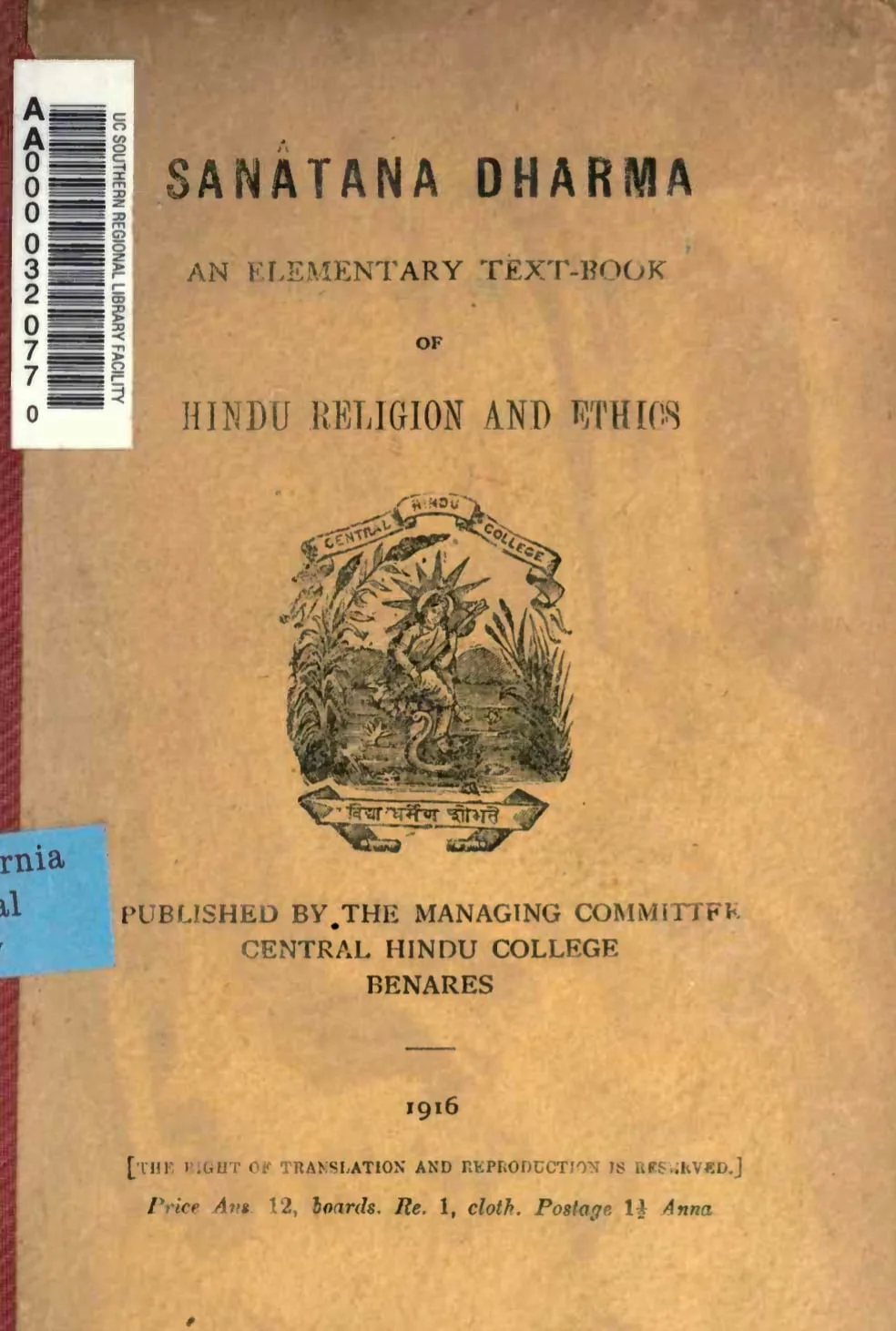
Source: 1916; Sanatana Dharma — An Elementary Textbook of Hindu Religion & Ethics; Central Hindu College, Benaras, and others.