
Tarkik had written the question at the bottom of the last page, after everything else was settled.
If every Jiva is learning its way back to Ishvara — what carries the learning when the body is gone?
He had stared at it for a while on the terrace, with the Ganga going gold below and Aindri quiet beside him. Then Dadi had come back with the reheated chai and set it down and looked at the notebook and said nothing. Which meant she had seen the question and decided it could wait until tomorrow.
Tomorrow was now. The chai was fresh. The Ganga had turned from morning silver to the particular amber it became when the sun cleared the rooftops.
And then came the knock at the door.
Dadi looked at Tarkik. Tarkik looked at Aindri.
“I didn’t tell him we were here,” Tarkik said.
“Neither did I,” Aindri said.
Dadi went to the door herself. A pause. Then, from below: “Dadi-ji, I’m Akshay. I go to school with Tarkik. I was in the area.”

There was a silence in which Tarkik could practically hear Dadi’s expression — the small private smile, not the pedagogical one.
“You were in the area,” she said. “Of Haridwar.”
“My cousin lives here. I thought I’d visit. And I thought Tarkik might be here. And—” A pause. “I brought mithai.”
She let him in.
Akshay appeared on the terrace two minutes later, slightly out of breath, a small box of laddoos in his hand, taking in the Ganga and the terrace and Tarkik and Aindri with the expression of someone who had made an excellent decision and knew it.
“You have a notebook open,” he said to Tarkik. “You’re going to ask her something complicated, aren’t you.”
“I already did. Yesterday.”
“And she didn’t answer yet?”
“She said it could wait until today.”
Akshay sat down, opened the laddoo box, and offered it around. “Good. I’m here.”
— — —
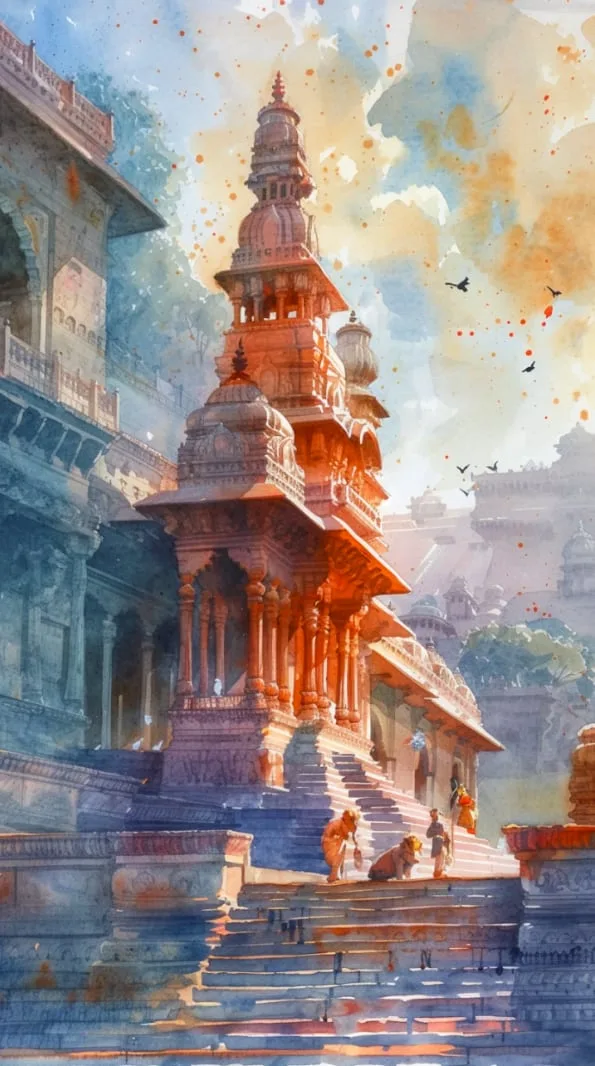
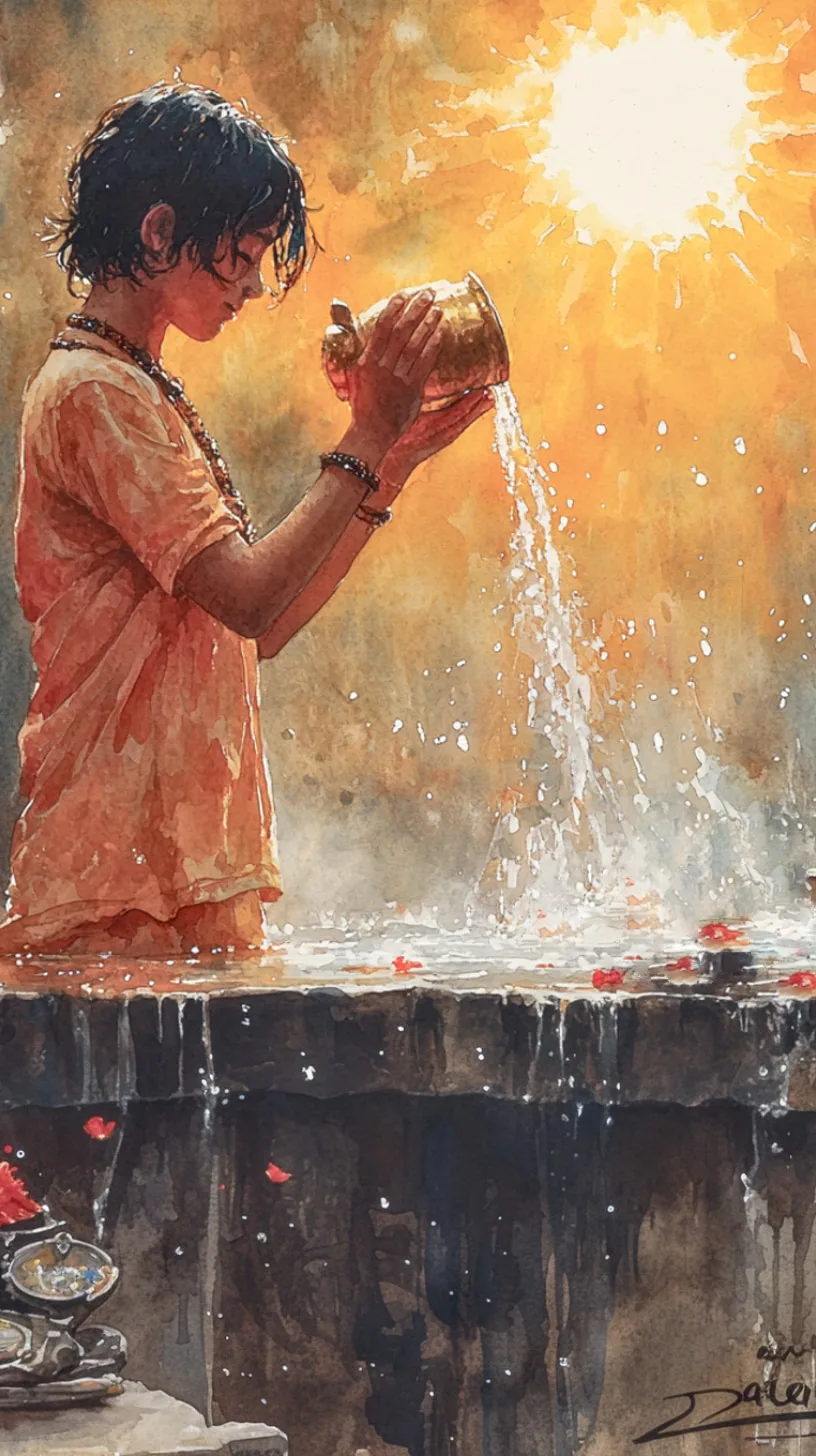
The terrace smelled of marigold smoke from a puja somewhere below and the particular sharpness of Haridwar mornings — river water and stone and something ancient that had no name. The Ganga moved in broad, unhurried amber, catching the mid-morning light in long shifting ripples.
Dadi settled into her chair and looked at all three of them.
“Three,” she said, the way someone notes a pleasing coincidence. “Good.”
Tarkik turned the notebook toward her. She read the question again, though she had clearly been thinking about it since last night.
“Read it aloud,” she said. “For Akshay.”
Tarkik read: “If every Jiva is learning its way back to Ishvara — what carries the learning when the body is gone?”
Akshay’s expression shifted — from laddoo-eating contentment to the quieter, more attentive face he had when something had actually reached him. “That’s a good question.”
“It came from the last conversation,” Aindri said. “We were talking about Samsara — the wheel. Every Jiva passing from form to form. Mineral to plant to animal to human.”
“Back up,” Akshay said. “The last conversation. What was the last conversation?”
Aindri glanced at Tarkik. He gestured at her to go ahead — she was always better at the short version.
“Okay. Short version. Two weeks ago, on the train down, Tarkik asked what Brahman is. One thing led to another, and Dadi explained the whole picture — Brahman as the one consciousness underneath everything, Ishvara as that same consciousness actively creating, the universe as Ishvara thinking out loud. Then she got to Samsara — the idea that every Jiva, every individual spark of consciousness, is working its way through form after form, learning its way back to Ishvara. Mineral, plant, animal, human.” She paused. “We stopped there.”
“You stopped at human?”
“We stopped at the wheel,” Tarkik said. “At the question of what keeps the Jiva on it. Which is also the question of what gets it off.”
“And that question became this question,” Akshay said, reading the notebook again. “What carries the learning when the body is gone.”
“Exactly,” Tarkik said. “And the question is — if the body dies, what keeps going?”
“Exactly,” Tarkik said. He looked at Dadi. “Not memories. The body carries memories. The brain stores them. When the brain dissolves—” He stopped. “So it isn’t memories. What is it?”
Dadi looked at the river for a moment. Then: “Tell me what a seed is.”
— — —
“A seed,” Tarkik said carefully, “is a compressed version of the tree. Everything the tree will become is already inside it. Dormant. Waiting to unfold.”
“Good. And when that tree grows and produces its own seed — what does it give the seed?”
“Its own nature. The seed of a mango tree will only ever become a mango tree. Never a banyan.”
“The Jiva is the same,” Dadi said. “Ishvara drops the Jiva into matter the way a tree drops a seed. The Jiva contains everything Ishvara is — all the same powers, all the same nature. But compressed. Dormant. Not yet unfolded.” She paused. “Evolution is the unfolding.”
“So the Jiva doesn’t learn things from outside,” Aindri said slowly. “It unfolds things from inside.”
“The rishis put it precisely: the senses are pierced from within outwards. The Jiva doesn’t receive eyes — it grows them. From the inside, pushing outward, because it wants to see. Agni gives it the right kind of matter — matter that responds to light. But the wanting, the push — that comes from the Jiva itself.”
Akshay said, “So the eye exists because something inside wanted to see?”
“Long before there was an eye, there was a Jiva pressing against the wall of matter that surrounded it — trying to perceive the light it could somehow sense was there. Over vast, unimaginable stretches of time, that pressure slowly shaped matter into something that could respond to light.” She looked at him. “That is how an eye came to exist.”
Akshay was quiet for a moment. “That’s the strangest thing I’ve heard in a long time,” he said. “And also — somehow — it makes complete sense.”
— — —
“Walk me through the journey,” Tarkik said. “Mineral to human. What actually happens at each stage?”
“In the mineral kingdom, the Jiva is almost entirely unconscious of the outer world. It exists inside rock, inside stone, inside the deep earth. The only thing that reaches it — that forces it to notice there is something outside itself — is shock. Earthquakes. Volcanic eruptions. The grinding of glaciers. The furious surf.” She let that settle. “The early history of this planet reads like a catalogue of catastrophes. Those catastrophes were not accidents. They were the curriculum.”
“The Jiva gets shaken awake,” Aindri said.
“Over a very, very long time — shaken awake enough that it is ready for a more flexible body. It passes into the plant kingdom. Now it can feel the sun. The rain. The slow turn of seasons. It grows more sensitive, moves from smaller plants into shrubs, into trees. More of its inner powers unfold.”
“And then animals,” Tarkik said.
“In the animal kingdom the Jiva evolves much faster. Hunting for food. Competing. Outwitting. The senses sharpen. Simple mental powers emerge. And eventually the animal form is no longer enough — the Jiva needs the human form to continue unfolding.”
“And in human form?” Akshay asked.
“In human form, for the first time, the Jiva has the capacity to choose consciously. To ask questions.” She looked directly at him. “To sit on a terrace in Haridwar and wonder what carries the learning between lives.”

Akshay looked briefly as though he’d been caught doing something more significant than he’d intended.
— — —
“So,” Tarkik said, bringing it back. “The notebook question. What actually carries the learning when the body goes?”
Dadi looked at him steadily. “Tell me what changes when you learn something deeply. Not what you know. What you become.”
He thought about it seriously. “You become someone who sees differently. Even when you’re not thinking about what you learned — it changes how you look at things.”
“That change — that shift in how you see — is not stored in your memories. It is stored in your character. In the shape of the mind you have become.” She paused. “When the body dissolves, the memories go with it. But the character — the actual shape of the Jiva, what it has become through everything it has experienced — that does not dissolve. That is what it carries forward.”
“Character,” Tarkik said.
“And alongside character — desire. What the Jiva still wants. What it is still reaching toward. These are the two threads it carries from one life to the next. Not memories. Not skills. Not the language it spoke or the face it wore. The shape of what it has become, and the direction it is still pulling toward.”
Aindri said, quietly: “So you can’t remember your past lives. But you are them.”
Dadi turned to her with the real smile — the small private one. “Yes. Exactly that.”
Tarkik wrote it down word for word.
— — —
The sun had moved. The terrace shadow had shifted. Akshay had finished two laddoos without noticing.
“So character and desire cross over,” Tarkik said. “But—” He paused, pen hovering. “Desire is what keeps the Jiva on the wheel. It comes back because it still wants things. So what breaks that? What actually gets a Jiva off the wheel?”
Dadi looked at him for a long moment.
“That,” she said, “is Part Two.”
Akshay looked up from the laddoo box. “There’s a Part Two?”
“There’s always a Part Two,” Aindri said.
— — —
To be continued in Part Two: The Rope and the River — what desire actually is, how karma is built from three threads, and what it means to be free.
Source: 1916; Sanatana Dharma — An Elementary Textbook of Hindu Religion & Ethics; Central Hindu College, Benaras, and others.