

The autumn air in Mysore smelled of jasmine flowers and fresh marigolds. Colourful rangoli patterns decorated every doorstep, and bright paper lanterns swayed from balconies. Dussehra was coming—Ria’s favourite festival of the year!
“Attention, children!” Lakshmi Aunty clapped her hands in the community hall. Twenty excited children sat cross-legged on the floor, buzzing with anticipation. “It’s time to announce the roles for our Dussehra tableau!”
Ria squeezed her best friend Amit’s hand. Every year, the neighbourhood children performed scenes from the Ramayana on Dussehra evening. All the families would come to watch, and afterwards, there would be sweets and sparklers.
“The role of Lord Rama goes to… Raghav!”
Raghav pumped his fist in the air. The older boy had been hoping for this role all year.
“And the role of Sita goes to… Ria!”
Ria’s heart soared like a kite catching wind. Sita! The brave princess who faced every challenge with courage and grace!
“I’ll be Lakshmana, Rama’s brother!” Amit whispered excitedly. “We’ll practice every day!”
Ria noticed that Priya wasn’t at the announcement. That was strange—Priya had played important roles for the past three years. But maybe she was just busy.
Over the next few days, the children rehearsed in the community garden. Ria learned her lines, practiced her graceful movements, and imagined herself as the wise princess who never gave up hope. The golden afternoon sun painted everything warm and bright as they acted out scenes under the neem trees.
Then, on the third day of rehearsal, everything changed.
Priya appeared at the garden gate, not in rehearsal clothes but in trendy jeans and a sparkly top. She wasn’t alone—two girls from her class stood behind her, giggling.
“Everyone, listen up!” Priya called out, leaning against the gate. “I’m not doing the tableau this year. I’m doing something way better—throwing a Dussehra party at my house! There’ll be chocolate cake, pizza, video games, and a treasure hunt with real prizes!”
The children stopped rehearsing and gathered around, chattering excitedly.
“But,” Priya continued, holding up one finger, “it’s the same evening as the tableau. So you have to choose—boring old performance for aunties and uncles, or the coolest party of the year!” She looked directly at Ria. “Ria, you should definitely come. You’re too smart to waste time on baby stuff.”
Ria’s stomach did a flip-flop. Was Priya inviting her? Priya, who was popular and confident, always had the latest toys. Priya, who thought she was too mature for “childish” things like community plays?
“Wait,” Amit frowned. “But we’re all practising for the tableau. Lakshmi Aunty is counting on us.”
Priya shrugged. “It’s just a children’s play. My party will be way more fun. We’re not little kids anymore. Right, Ria?”
All eyes turned to Ria. Her face felt hot. “I… I don’t know. I need to think about it.”
Raghav crossed his arms. “I’m doing the tableau. I gave my word.”
“Suit yourself,” Priya said breezily. “But everyone who’s anyone will be at my party. Your choice—be cool or be boring.” She walked away, her friends following, their laughter floating back over their shoulders.
That evening, Ria sat on her balcony, swinging her legs and watching the sunset paint the sky with orange and pink hues. Below, she could see the community decorators putting up strings of lights for Dussehra. In the distance, the giant Ravana effigy was being built—it grew taller every day.
“What’s troubling my little princess?” Appa came and sat beside her, his newspaper folded under his arm.
“Appa, what would you do if you had to choose between something fun and something you promised to do?”
Appa thought for a moment. “Tell me more.”
Ria explained everything—Priya’s party, the tableau, feeling torn in two directions. “Priya says the tableau is baby stuff. Maybe she’s right. Maybe I’m too old for it.”
“Hmm,” Appa said. “You know, that reminds me of something. Would you like to see something special tomorrow?”
The next morning, Appa took Ria to the open ground where the artisans were building the giant Ravana effigy. The demon king stood fifteen feet tall already, with bamboo arms reaching toward the sky. Workers climbed on scaffolding, carefully attaching his fierce ten heads, each one more terrifying than the last.
“Every year, we burn Ravana on Dussehra,” Appa said. “Do you know why?”
“Because Rama defeated him?”
“Yes, but do you know what made Rama and Sita heroes? It wasn’t just that they won the battle.” Appa sat on a nearby bench and patted the spot beside him. “Rama was a prince living in a palace. He could have had comfort, parties, and fun every single day. But he gave it all up to keep his father’s promise and went to live in the forest for fourteen years.”
Ria watched the workers add Ravana’s crown, decorated with gold paper and red cloth.
“And Sita,” Appa continued, “could have stayed safely in the palace. Everyone told her the forest was dangerous and difficult. But she chose to go with Rama because she had made a commitment. Even when Ravana captured her, she never gave up her values or her dignity. That wasn’t easy or comfortable. But it was right.”
“So being a hero isn’t about doing easy things?”
“Exactly,” Appa smiled. “All through their journey, Rama and Sita faced temptations—shortcuts they could have taken, promises they could have broken, easier paths. But they always chose what was right over what was easy. That’s why we celebrate Dussehra—it’s not just about defeating a demon with ten heads. It’s about defeating the little demons inside us, the ones that say ‘take the easy way’ or ‘break your promise if something better comes along.'”
Ria chewed her lip, thinking hard.
Over the next two days, the pressure grew heavier, like a backpack filled with rocks. During rehearsal, three children dropped out to attend Priya’s party. Lakshmi Aunty’s smile became worried.
“If more children leave, we might have to cancel the whole tableau,” she said quietly.
Priya showed up at the park where Ria was playing. “My mom ordered a special chocolate fountain! And there’ll be a magic show. You’re still coming, right? Don’t be silly and waste your time on that performance. Nobody cool is doing it.”
She showed Ria pictures on her phone—fancy decorations, a giant cake, colourful balloons. “See? This is what mature people do for festivals. Not dress up and recite old stories.”
Amit stayed quiet, but Ria could see disappointment in his eyes. He was practising his lines extra hard, even at home. Raghav had asked Ria twice if she was definitely staying in the tableau—he needed to know if they should find a new Sita.
That night, Ria couldn’t sleep. She lay in bed, staring at her Sita costume hanging on the closet door—a beautiful green and gold saree that Amma had sewn with great care, featuring tiny mirrors that caught the light like stars. She thought about Lakshmi Aunty, who had been organising this tableau for twenty years. She thought about the little six-year-old playing Hanuman, who had told Ria, “I want to be brave like Sita when I grow up.”
But she also thought about Priya’s chocolate fountain. And being part of the cool group. And not being called a baby. And having fun instead of working hard.
“What do I do?” she whispered to the darkness.
The next morning was Dussehra eve—decision day. The final rehearsal was at four o’clock. Priya’s party invitation said to arrive at six.
Ria walked slowly to the community garden, her feet feeling heavy. When she arrived, she saw the stage decorated with paper flowers and painted clouds. The smaller children were practising their parts with enthusiasm. Amit was helping a nervous five-year-old remember his lines. Raghav was adjusting his crown, looking worried as he counted the children who hadn’t shown up.
Lakshmi Aunty looked tired but hopeful. “Ria! Thank goodness you’re here. We’ve been waiting for our Sita.”
Ria looked around. Half the cast was gone. But the ones who remained were trying twice as hard to make up for it. Little Meena, playing a tree in the forest, had made paper leaves at home and glued them to her costume. Amit had painted his toy sword silver to make it look more realistic.
These were her friends. Real friends. People who showed up and kept trying even when things got hard. People who didn’t think helping their community was “baby stuff.”
Suddenly, Ria understood what Appa had been trying to tell her. Keeping promises wasn’t childish—it was what grown-ups did. Real maturity wasn’t about chocolate fountains and being “too cool” for traditions. It was about being dependable.
“Lakshmi Aunty,” Ria said, standing up straight, “I’m staying in the tableau. I made a promise, and I’m keeping it.”
Raghav’s worried face broke into a huge smile. “Really? That’s great! I knew you wouldn’t let us down!”
Amit grinned. “Now we can really make this work!”
“Really,” Ria said firmly. “Let’s make this the best performance ever!”
They rehearsed until the sun began to set, perfecting every scene, every gesture, every line. Raghav and Ria practised the scene where Rama finds Sita again, and even though it was just a rehearsal, Ria felt the emotion of the moment—the joy of reunion, the strength of loyalty.
At five-thirty, Priya appeared at the garden gate in a sparkly purple party dress, her hair done up in elaborate curls. “Ria! Come on! The party’s starting soon! Last chance to be cool!”
Ria took a deep breath. Her heart hammered, but her voice was steady. “I’m performing in the tableau, Priya. I gave my word.”
Priya’s eyes widened. “You’re choosing that baby play over my party? Seriously? Fine. Be boring. You’ll miss the best party of the year!” She flounced away, her dress swishing. “You’ll be sorry!”
Ria’s stomach hurt, but she also felt something else—something solid and warm, like the sun on her face. She felt proud.
Raghav walked over and gave her a high-five. “That took guts. Thanks for sticking with us.”
As twilight painted the sky purple, families began arriving with blankets and floor cushions. The community ground filled with people, and oil lamps flickered around the stage. The giant Ravana effigy stood ready in the distance, waiting for its moment.
The tabla drums began. The performance started.
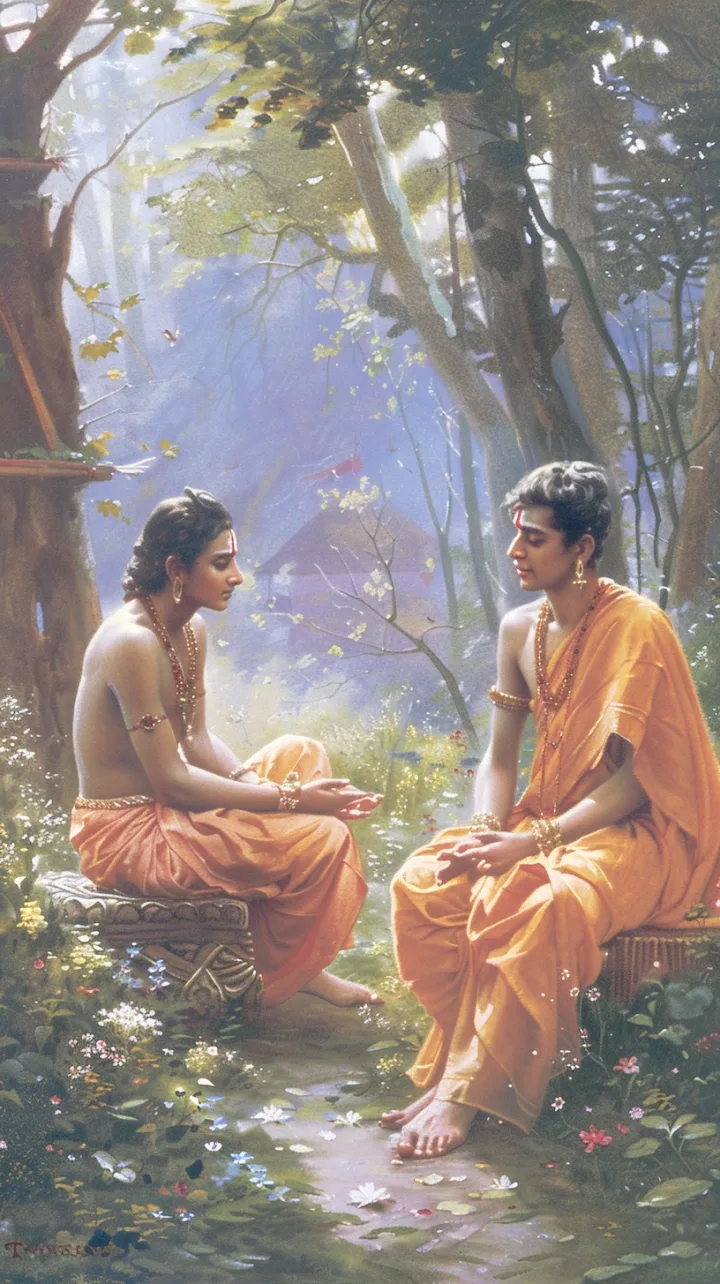
Ria stepped onto the stage in her green and gold costume, and suddenly, she wasn’t Ria anymore—she was Sita. She spoke her lines clearly, moved with grace, and showed everyone what true courage looked like. Raghav was a perfect Rama, noble and strong. Amit was a loyal Lakshmana. Even with their smaller cast, the children performed with such heart that the audience sat in complete silence, captivated.
When Rama and Sita were reunited in the final scene, many people in the audience wiped their eyes. When the performance ended, the crowd erupted in applause that seemed to shake the stars.
“That was wonderful!” people called out. “Beautiful!”
Little Meena hugged Ria. “You were the best Sita ever! You made me cry!”
After the performance, as the adults lit the giant Ravana effigy, flames climbed toward the sky, and someone started playing music. Families spread out picnic blankets, sharing homemade laddoos, samosas, and jalebi. Children played with sparklers, writing their names in light against the darkness.
Lakshmi Aunty found Ria in the crowd and hugged her tight. “Thank you for staying. You showed everyone what it means to keep a promise. That’s not baby stuff—that’s what real maturity looks like.”
Appa appeared with a plate of sweets. “Proud of you, my brave Sita.”
Ria looked around at the smiling faces, the warm glow of the fire, and the laughter of her friends. This—this feeling of belonging, of having done something meaningful—was better than any fancy party could ever be.
The next afternoon, Ria was playing hopscotch outside when she saw Priya sitting alone on a bench, looking at her phone with a frown.
“How was your party?” Ria asked carefully.
Priya shrugged, not meeting her eyes. “It was okay. Some kids left early because they said it was boring. Half the people I invited didn’t even show up—they went to the tableau instead.” She paused, then added quietly, “My cousin showed me videos of your performance. You were excellent. Everyone’s talking about it today.”
Ria sat down beside her. “Thanks. Hey, Lakshmi Aunty is already planning next year’s performance. You should join us from the beginning this time. It’s a lot of work, but it’s worth it. And it’s definitely not baby stuff.”
Priya looked surprised. “Even after I tried to make everyone skip it? Even after I called it boring?”
“Everyone makes mistakes,” Ria said, remembering what Appa had taught her. “What matters is what we choose to do next. Real friends don’t give up on each other.”
A small smile appeared on Priya’s face. “Maybe I was wrong. Maybe running away from traditions because I think I’m too cool isn’t very mature at all.”
“Maybe,” Ria agreed gently.
“I think I will join next year,” Priya said. “If you’ll have me.”
“Of course,” Ria smiled. “Everyone’s welcome.”
That evening, as Ria helped Amma water the tulsi plant on their balcony, she looked up at the stars beginning to appear.
“Appa?” she called inside. “I think I understand now. Dussehra isn’t just about burning a statue of a bad guy.”
Appa came to the balcony. “What is it about?”
“It’s about choosing what’s right even when it’s hard. It’s about keeping promises. It’s about being the kind of person you can be proud of.” Ria smiled. “It’s about defeating the demons inside us—like the demon that tells us to break our word, or that traditions are childish, or that being popular is more important than being dependable.”
Appa pulled her close. “Now you truly understand, my brave one. And that’s the real victory we celebrate. Real maturity isn’t about being too cool for traditions—it’s about honouring them and understanding why they matter.”
As the evening drifted into the night sky like tiny stars, Ria felt something settle inside her—a quiet confidence, a sense of who she was and who she wanted to be.
She had made the right choice. And that was the best feeling in the world.