The Many: How One Became Everything
The question had come from something Dadi had said on his last visit.
She had been explaining Brahman — the One Existence, the vast ocean from which all things rise and to which all things return — and Tarkik had understood it, or thought he had. But on the train home, staring at the flat fields outside the window, a different question had surfaced, the kind that interrupts sleep.
If Brahman is one, why does the world look like so many? And more precisely: how, exactly, did the Many come from the One?
He’d written it in his notebook that evening: Why does each new element bring a new sense with it? What does that tell us about what the universe actually is?
Three weeks later, it was still there. Unanswered.
It was Aindri who found him staring at it.
“You’ve been looking at that notebook for twenty minutes,” she said from across the common room, not looking up from her own book. “Either write something or close it.”

“I’m thinking.”
“You’re brooding. Different thing.”
Tarkik turned the notebook toward her. She read the question, said nothing for a moment, then: “So ask Dadi.”
“I’m not going to Haridwar just to ask one question.”
“It’s never just one question with you.” She closed her book. “Also, it’s Ekadashi on Saturday. I want to go. You’re my excuse.”
He looked at her. Aindri didn’t need excuses for anything. She went where she wanted to go.
“Fine,” she said. “I want to go and you need to go. Neither of us is the excuse. Bring the notebook.”
— — —
Haridwar in the early morning smelled like river water and wood smoke and marigolds left to slowly release their sweetness into the air. The Ganga moved in broad, unhurried silver at the bottom of the ghats — the colour water only becomes before the city fully wakes.
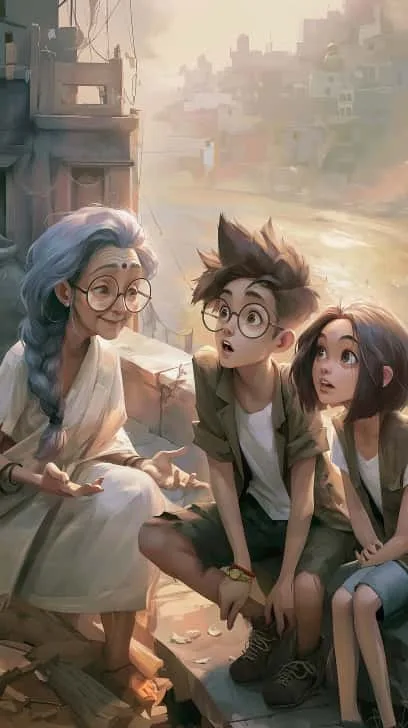
Dadi was already on the terrace when they arrived, a cup of chai going cold beside her. She looked up before they reached the top step.
“I was wondering which question it would be this time,” she said.
Tarkik touched her feet. Aindri did the same, with the easy unselfconsciousness she had about these things that he still found slightly surprising.
“He’s had it in his notebook for three weeks,” Aindri offered.
Dadi looked at Tarkik with the small, private smile — not the pedagogical one. “Show me.”
He handed her the notebook. She read the question. Set it down. Picked up her chai, found it cold, set that down too.
“Good,” she said. “Sit.”
— — —
“Last time,” Tarkik said, settling into the cane chair, “you told me about Brahman. The One. The ocean from which all waves rise.” He paused. “I understand that. But you also said that Brahman, when it turns toward creation, is called Ishvara. And I realised I don’t actually know what that means. How can the same thing have two names?”
“Good,” Dadi said. “Before the Many, you need to understand that.”
“So tell me.”
“Think of the ocean,” she said. “When it is still and vast and undisturbed — what is it?”
“Just water. Formless.”
“That is Brahman — unmanifest, without form, without attributes. The One, before anything exists. But when the ocean stirs — when waves begin, when currents form, when the whole thing becomes active — is it a different ocean?”
“No. Same ocean.”

“The same Brahman, made active, turned toward creation, is what we call Ishvara. The Supreme Lord. Brahman with intention. Brahman looking outward.” She looked at him steadily. “Not a different being. The same being in its active aspect. The way the sun is always the sun — but it both shines and sets.”
Tarkik wrote that down. Aindri was watching the river below, but he could tell she was listening.
“So when we say the Many came from the One,” he said, “we mean Ishvara — Brahman-turned-active — began to create.”
“Exactly. And the first thing that appears when Ishvara turns toward creation is not a mountain or a river or a human being.” She let a beat pass. “It is three aspects of Ishvara Himself. Three faces. Three roles.”
— — —
“Think of the sun again,” Dadi said. “What does it do?”
“Gives light. Gives heat. And at the end of the day, it sets — withdraws both.”
“Three actions. One sun. Ishvara works the same way. His three aspects run the universe. The first is Brahma — the Creator. Brahma shapes the raw material of matter into form, the way a potter shapes clay into a vessel. Everything that exists was first a thought in the mind of Brahma.”
“The second is Vishnu — the Preserver. Once the worlds exist, they must be held together, maintained, kept on the right path. Vishnu is that force. Steady, all-pervading.”
“And the third?” Aindri said, from her spot at the railing.
“Shiva. The Dissolver. When a universe has run its course — when its forms are worn out and can go no further — Shiva dissolves them. Not destruction for its own sake.” She paused. “To free what was inside them. So it can return to Brahman and begin again.”
“Create, preserve, dissolve,” Tarkik said slowly.
“On and on. Like breathing. These three — Brahma, Vishnu, Shiva — are called the Trimurti. Not three separate gods competing with each other. Three aspects of the same One, working in perfect sequence.”

Tarkik wrote that in his notebook.
— — —
“So Brahma creates,” Tarkik said. “But what does He create from, and in what order?”
“The ancient teachers gave us a precise answer. Brahma does not throw everything together at once. He builds the universe in layers — seven of them, called Tattvas. Each one arising from the one before it. Each one a little more solid, a little more physical, than the last.”
“The first is Mahat-Buddhi — Pure Intelligence. The very first stirring of awareness in matter. Before anything has a shape, there is this: a vast capacity to know.”
“And from that?”
“Ahamkara — the principle of separation. Think of it this way: if everything stayed merged into one, nothing distinct could ever exist. Ahamkara is the moment the universe begins to think of itself as many rather than one. Because of it, distinct things — individual atoms, individual beings — become possible.”
Aindri turned from the railing. “So separation isn’t a mistake? It’s built in on purpose?”
“Built in deliberately,” Dadi said. “So that creation can happen at all. And then come the five great elements, one inside the other, each arising from the subtler one before. Name them.”
Tarkik read from his notes. “Akasha — ether, or space. Vayu — air. Agni — fire. Apa — water. Prithivi — earth.”
“Good. Now — this is the question you’ve been carrying for three weeks. What does each element bring with it?”
He thought carefully. “Akasha brings sound. Vayu brings touch. Agni brings sight. Apa brings taste. Prithivi brings smell.”
Silence on the terrace. Below, the Ganga moved, silver going slowly gold as the morning advanced.
“Say what you’re seeing,” Dadi said.
“Each new element brings a new sense with it.” He stopped. “Which means — the universe isn’t just building matter. It’s building the capacity to experience that matter. Simultaneously.”
“Go on.”
“Space comes into existence and sound becomes possible. Air — touch. Fire — sight. Water — taste. Earth — smell.” He put the pen down. “The universe is building a world that can be known. Not just a world. A world and its observer, at the same time.”
Aindri said nothing. She had been listening with the particular quality of attention she brought to things that moved her.
“The rishis’ answer to your question,” Dadi said quietly, “is that the universe is not a collection of things. It is a process of becoming knowable. Matter and consciousness unfolding together, layer by layer, each new layer bringing exactly the instrument needed to perceive it.”
Tarkik was already writing.
— — —
“Then Brahma creates the Indriyas,” Dadi continued. “The ten faculties of experience. Five face outward as senses — smell, taste, sight, touch, hearing, anchored in the nose, tongue, eyes, skin, and ears. Five more face outward as action — the hands, feet, voice, and the organs of creation and release. And at the centre of all of it, drawing in everything the senses collect, arranging it, thinking about it — Manah. The mind.”
“The mind as the eleventh,” Aindri said.
“Or the sixth, depending on how you count.” Dadi smiled. “And Brahma also creates the Devas — vast beings of light who administer the laws of Ishvara across the universe. Think of Ishvara as the great king. The Devas are his ministers — they see to it that each being receives what it has earned, that the world moves according to its dharma. They are not Brahman. They are Brahman’s instruments.”
— — —
“So Brahma has shaped the forms,” Tarkik said. “But a city of empty houses is still empty.”
“Exactly. This is where Vishnu acts. He breathes His life into every form — He becomes Prana, the life-breath, in all living things, giving them consciousness. The whole Brahmanda — the great universal egg of worlds — becomes full of life.” She looked at him. “But Vishnu’s work does not stop at the beginning of a universe. He stays with it. Preserves it. And when the universe goes off course — when dharma weakens, when evil grows too strong — Vishnu comes down into it Himself.”
“An Avatara,” Tarkik said.
“From the Sanskrit: ava, down, and tri, crossing over. Not just a divine visitor. Vishnu fully entering a form, to put something right that cannot be fixed from above.” She looked at both of them. “Ten Avataras are considered the most important. And if you look at them in order, they map something like the history of life itself.”
Aindri leaned forward. “My nani has a painting of all ten on her wall. I’ve looked at it my whole life. I never knew they were in order.”
“Let me show you,” Dadi said.
— — —
“Matsya, the Fish. The first Avatara comes in the age of the great waters, when animal life in the oceans was the highest form of life on earth. Vishnu appears as a fish and saves the seeds of life from a great flood — so that evolution can continue.”
“Life begins in water,” Tarkik said.
“Kurma, the Tortoise. Vishnu appears as the tortoise who supports the churning mountain as it stirs the great ocean of matter, drawing forth the forms creation needs. The tortoise lives in both worlds — water and land.”
“Varaha, the Boar. The earth sinks beneath the waters, and Vishnu lifts it up as a great boar. The age of the great land mammals. Life has moved fully onto land.”
“Modern science recognises these three stages,” Tarkik said slowly. “Marine life. Amphibian. Mammalian.”
“The ancient rishis saw it too. Narasimha, the Man-Lion — half human, half animal. The threshold. He comes to free the earth from a tyrant so powerful that no full god and no full mortal can stop him. Through a crack in the rules — neither god nor man, neither inside nor outside, neither by day nor by night — the Man-Lion finds a way. The age of the transition.”
“Vamana, the Dwarf. Vishnu comes as a small, unassuming man — and in three steps, claims the earth for the rightful evolution of humanity. The age of the human being has truly begun.”
“Parashurama, Rama of the Axe. He comes to punish those in power who have used that power to crush rather than protect. The age of human society — and its first great corruption.”
“Rama — Ramachandra, son of Dasharatha. The ideal human. An example of how a human life, lived with complete faithfulness to dharma, looks. Devoted son, loving husband, just king, fearless warrior. The Ramayanam is His story.”
“Krishna — divine love and wisdom, fully incarnated. The child of Vrindavana, the friend of Arjuna, the speaker of the Bhagavad Gita. At the heart of the Mahabharatam. Millions worship Him still — with the kind of love you give not to a distant god but to the dearest person you have ever known.”
“Buddha — the gentle prince who walked away from a throne to find the truth about suffering. Through him, Vishnu reaches vast multitudes who could not be reached any other way.”
“And the tenth?” Aindri said.
“Kalki — the Avatara yet to come. When this age reaches its end, Kalki will appear. The cycle will close. A new one will begin.”
The terrace was quiet for a long moment.
“Fish,” Tarkik said. “Tortoise. Boar. Man-Lion. Dwarf-become-cosmic. Axe-bearer. The ideal man. Divine wisdom. The truth-seeker. And the one still coming.” He looked at Dadi. “That’s not mythology arranged randomly. That’s a sequence. A record of how life unfolded on this earth.”
“The development and perfection of the human type,” Dadi said quietly. “That is exactly what the rishis called it.”
— — —
The Ganga had turned fully gold now. The aarti would begin downstream in an hour.
“There’s one more thing,” Tarkik said.
“There always is,” Dadi said.
“Samsara. The wheel. Every Jiva — every individual living self — passing from form to form across vast stretches of time. Mineral to plant to animal to human.” He tapped the notebook. “Why? What is the wheel turning toward?”
Dadi was quiet for a moment. Then — not as a lesson, but as something she had simply come to know: “The Jiva’s long journey home. Back to Ishvara. Back to the One from which it came. Every birth, every body, every experience — is one step in that direction. Even the difficult ones. Even the ones that feel like going backward.”
“So the Many,” Tarkik said slowly, “is not a mistake. It’s not the One falling apart. It’s the One—” He stopped.
“Say it fully,” Dadi said.
“It’s the One deliberately unfolding itself into experience. Building matter, building the senses to perceive matter, building minds to understand those senses, building Jivas to carry those minds — so that consciousness can know itself from the inside. Not from above. From within.” He paused. “And then the whole thing folds back. The Jiva returns. And it carries what it learned.”
Dadi said nothing.
Which was how he knew he’d said it right.
Aindri, who had been listening without speaking for a long time, said: “My nani has that painting. All ten Avataras in a row, in a gold frame, above the door. She’s had it since before my mother was born. She does puja to it every morning.” A pause. “She doesn’t know any of this. Nobody explained it to her. The painting stayed. The knowing left.”
Tarkik looked at her.
“That’s the second thing I needed to understand,” he said quietly.
— — —
He wrote in his notebook for several minutes after that, while Dadi went inside to reheat the chai and Aindri watched the Ganga below, her chin resting on her arms on the railing.

When he finished, he read it back to himself once. Then wrote the next question on a fresh line:
If every Jiva is learning its way back to Ishvara — what carries the learning when the body is gone?
He closed the notebook.
Below the terrace, the Ganga moved as it always had — full, unhurried, neither knowing it was watched nor needing to. It had been carrying things forward since before the city existed. It would carry them forward long after.
It did not require the question to be answered. It simply continued.
✦ 🪔 ✦
To be continued in the next story: Re-Birth — what actually happens when a Jiva leaves one body and takes another, and why the learning is never lost.