

The Sacred Rituals
The morning session of Gayatri Jayanti had ended, but the house remained alive with activity. Women in bright saris clustered in the kitchen, preparing prasad, while men arranged seating in the courtyard for the upcoming discourse. Children ran between the groups, their yellow clothes fluttering like butterfly wings.
“Tarkik beta, help me with these,” Dadi called, gesturing to a collection of brass items that needed arranging.
As Tarkik helped her sort through the vessels, he noticed each had specific contents – one filled with kumkum, another with rice, a third with what looked like yellow powder.
“Turmeric,” Dadi said, noticing his gaze. “For the tilak. Each person who comes for Gayatri Jayanti receives the sacred mark.”
She demonstrated on Ansh, who stood still for once, as she applied a small yellow mark on his forehead, then a red one above it.
“Why two colors?” Tarkik asked, then caught himself. He was supposed to be the skeptical one, not the curious questioner.
“Watch the pattern,” was all Dadi said, continuing to apply tilak to arriving guests.
And there was a pattern. Yellow first, then red. Rice grains pressed into the red kumkum. The same sequence every time. Even the movement of Dadi’s hand followed a specific path – circular for the yellow, vertical for the red.
“Dadi, tell us the story!” a young voice piped up. Several children had gathered, sitting cross-legged on the courtyard floor.
“Which story?” Dadi asked, though her smile suggested she knew exactly which one they wanted.
“The one about the sage and the impossible task!”
Dadi settled onto a low wooden seat, her sari pooling around her like yellow water. Even the adults paused their activities to listen. Tarkik found himself drawn in despite his intention to remain aloof.
“Long ago,” Dadi began, her voice taking on the timeless quality of all good storytellers, “there lived a king named Vishwamitra. He was powerful, proud, and believed human strength could conquer anything.”
The children leaned forward. Even Tarkik, who usually preferred scientific journals to stories, felt the pull of her words.
“But Vishwamitra met his match in Sage Vasishta, whose power came not from weapons or armies, but from something else entirely. Defeated and humbled, Vishwamitra realized true power lay elsewhere. He gave up his kingdom, his wealth, everything, and went to the forests to search for this greater strength.”
“What happened then?” Ansh whispered.
“He performed tapasya – meditation so intense that the universe itself took notice. For thousands of years, he stood on one leg, living on air alone, seeking the ultimate knowledge. The gods tested him with temptations, distractions, even sending the celestial dancer Menaka. But Vishwamitra persisted.”
Dadi paused, pouring water from a copper vessel into smaller cups, handing them around. The water had tulsi leaves floating in it, giving it a subtle fragrance.
“Finally,” she continued, “when his seeking became pure, when his ego dissolved completely, the universe revealed its greatest secret. In a flash of golden light, the divine knowledge descended. The words came to him – twenty-four syllables that contained the essence of all wisdom. The Gayatri Mantra.”
“The same one we chanted?” a little girl asked.
“The very same. And that’s why we celebrate Gayatri Jayanti – to remember the day supreme knowledge became available to humanity, the day a proud king became a Brahmarishi through the power of seeking truth.”
Tarkik noticed how the story worked on multiple levels. For the children, it was an adventure tale. For the adults, perhaps a spiritual lesson. But something nagged at him – the precision in the story. Thousands of years of meditation? A specific number of syllables? It sounded almost like… data encoded in narrative form.
“Now,” Dadi stood, “who wants to help prepare for the noon sandhya?”
The crowd dispersed, returning to their tasks. Tarkik found himself assigned to flower duty with Aindri and some cousins. They sat in a circle, removing marigold petals and arranging them in patterns.
“These go on the rangoli,” his aunt explained, pointing to the intricate design drawn in rice powder at the entrance. “Each color in its proper place.”
Tarkik watched as they worked. The rangoli wasn’t random – it was a complex geometric pattern with perfect symmetry. Circles within squares within triangles. Mathematical relationships everywhere he looked.

“Your turn,” Aindri nudged him, passing a basket of petals.
As Tarkik placed the bright yellow petals, he noticed they were adding them in a spiral pattern, working from the outside in. The design seemed to draw the eye toward the center, where a small oil lamp would be placed.
“Why this specific design?” he found himself asking.
His aunt smiled. “It’s always been done this way. My mother taught me, her mother taught her. The design is… special.”
Special how? Tarkik wanted to ask, but a commotion at the gate distracted him.
A group of pandits had arrived, carrying items for the noon ceremony. Among them was someone unexpected – Tarkik’s physics teacher from Himshikhar, Mr. Sharma.
“Sir?” Tarkik stammered. “You’re here for Gayatri Jayanti?”
Mr. Sharma smiled, adjusting his yellow shawl. “Your grandmother invited me. She and I have had many interesting discussions about the connections between ancient practices and modern science. Today seems perfect for continuing those conversations.”
Connections? Science? Tarkik’s mind raced, but before he could ask more, the preparation for noon sandhya began.
The sun had climbed to its zenith. Tarkik noticed people checking their watches, some consulting what looked like a detailed calendar with astronomical data.
“11:47 AM,” someone announced. “Fifteen minutes to perfect noon position.”
Perfect noon position? Tarkik knew from his geography classes that solar noon varied from clock noon, depending on location and time of year. Were they actually calculating true solar noon?
The group assembled again, this time in a different part of the courtyard where the noon sun fell directly. The heat was intense, but somehow the ritual arrangement – white cloth canopies, strategic positioning, the cooling effect of water sprinkled on the ground – made it bearable.
“The second sandhya,” Dadi announced, “when the sun stands at its most powerful.”
Again, the Gayatri mantra filled the air. But this time, Tarkik noticed differences. The pitch was slightly higher, the tempo marginally faster. The offerings in the havan were different too – more ghee, different herbs, producing a clearer flame that stood straight despite the noon breeze.
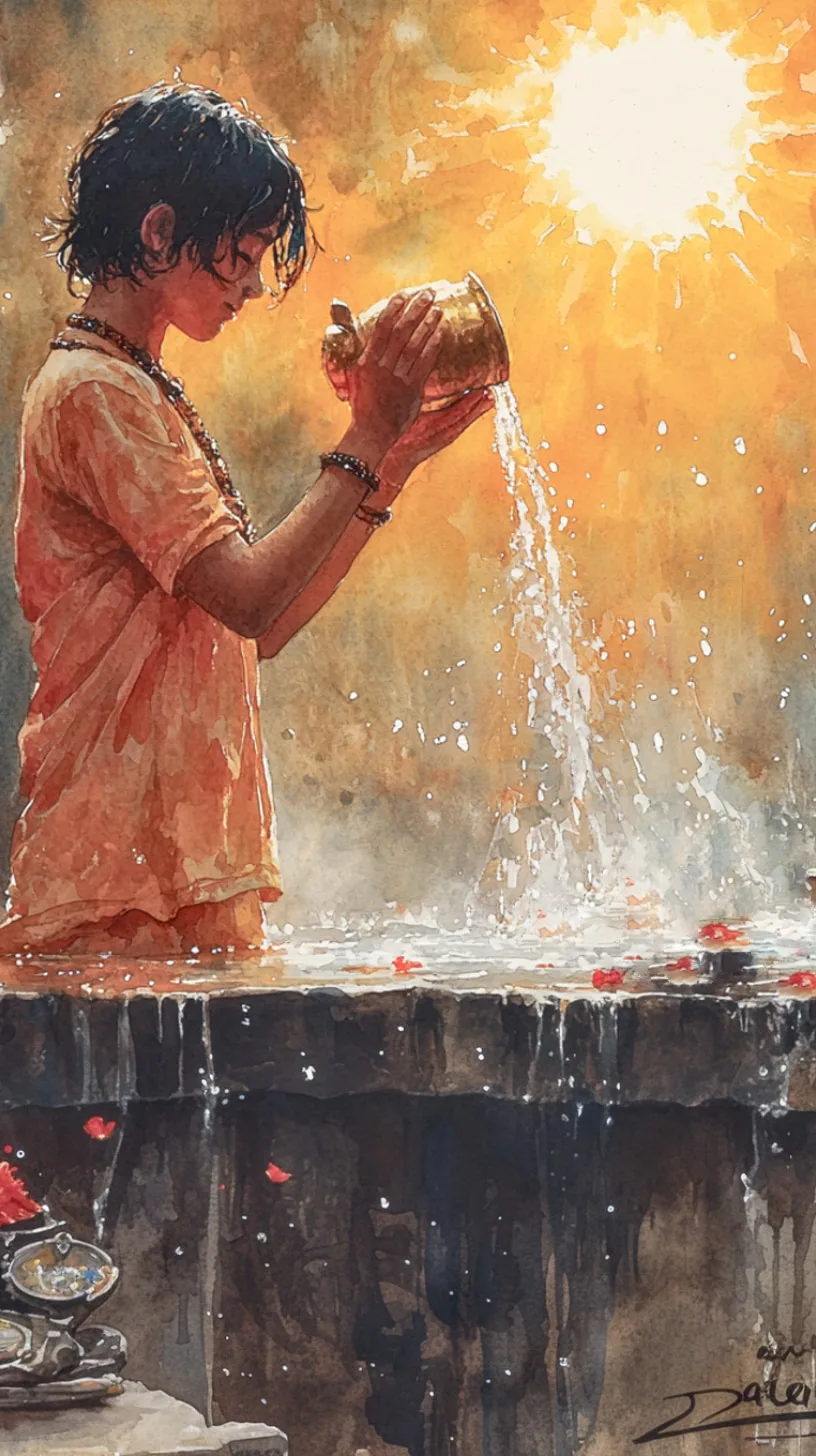
As they performed the water offering, Tarkik saw how the angle of pouring had changed to match the sun’s position. The water caught the light differently, creating not rainbows but an almost blinding sparkle.
“Each sandhya is unique,” someone beside him murmured. It was the elderly man from morning. “Your grandmother could explain the astronomical reasons, but I just know it feels different.”
Astronomical reasons? Tarkik filed this away with his growing list of mysteries.
The noon ritual was shorter but more intense. When it ended, everyone looked energized rather than tired, despite the heat. Prasad was distributed – kheer with saffron, its golden color matching the theme of the day.
“Rest now,” Dadi advised. “The evening sandhya is still to come, and then the night-long celebration at the temple.”
Night-long? Tarkik hadn’t known about that part.
As people settled in various parts of the house for the afternoon break, Tarkik found himself on the veranda with Aindri, processing everything he’d witnessed.
“It’s all so precise,” he said finally. “The timing, the materials, the sequences. It’s like… like a carefully designed experiment. But for what?”
Aindri smiled. “Maybe that’s what you need to find out. Dadi always says knowledge comes to those who seek it properly.”
“But I am seeking! I’ve been observing, noting patterns, trying to understand—”
“Are you?” Aindri interrupted gently. “Or are you just collecting data from the outside? Maybe some experiments need you to be part of them to understand the results.”
Before Tarkik could argue, Ansh appeared, tugging at his kurta. “Bhaiya, Dadi says to come. She wants to show us something in her study before evening prayers.”
Her study? Tarkik had never been invited there before. As he stood to follow Ansh, he caught sight of the sun through the window. It was beginning its descent, painting the mountain peaks gold. Soon it would be time for the third sandhya, the third set of mysteries in this increasingly intriguing day.Gayatri Jayanti was revealing itself to be far more complex than any religious festival he’d dismissed before. And somehow, Tarkik suspected, the biggest revelations were yet to come.
PREVIOUS: Dawn Immersion
NEXT: The Three Mysteries