

Dawn Immersion
The house bustled with quiet activity. Tarkik found himself swept along in a current of preparation for Gayatri Jayanti, each family member moving with practiced purpose. The very air seemed different – charged with anticipation.
“First, the bath,” Dadi announced, handing them fresh towels. “Gayatri Jayanti begins with purity – of body, mind, and spirit.”
The bathroom had been prepared with a bucket of warm water infused with something that made it shimmer golden in the lamplight. Neem leaves floated on the surface, and the scent of sandalwood filled the small space.
“What’s in the water?” Tarkik asked, sniffing cautiously.
“Tradition,” Dadi said simply, her eyes twinkling. “Now hurry. The sun won’t wait for curious boys.”
After bathing, Tarkik emerged to find yellow clothes laid out – a simple cotton kurta-pajama set. The fabric felt different somehow, softer than usual. Aindri was already dressed, helping Ansh adjust his small turban.
“Yellow everywhere,” Tarkik observed. “Even the flowers.”
Indeed, the house bloomed with marigolds and yellow chrysanthemums. Every doorway, every window, every available surface held brass vessels filled with golden blooms. Their sweet, slightly sharp scent mixed with the sandalwood incense creating an almost hypnotic atmosphere.
“Come,” Dadi beckoned. “Time to learn the mantra.”
They gathered in the puja room, where Tarkik’s aunt had already lit numerous brass lamps. The flames danced, casting moving shadows on the walls. In the centre sat a beautiful image – a goddess with five faces, each serene and knowing, ten arms holding various objects Tarkik couldn’t identify.
“That’s Goddess Gayatri,” Aindri whispered. “See how she sits on the lotus? And that’s Hamsa, the sacred swan.”
Tarkik studied the image. Five faces? Ten arms? It seemed like something from a fantasy movie, yet the artist had rendered her with such detail, such conviction. The swan beneath her looked ready to take flight.
“Now, repeat after me,” Dadi began. “Om bhur bhuvah svah…”
The syllables felt strange on Tarkik’s tongue. Not Hindi, not English, something older. He stumbled over the pronunciation.
“Tat savitur varenyam…”
Around him, voices joined in – his cousins, aunts, uncles, even the household helper who had worked for Dadi for twenty years. The sound built, layered, creating a rhythm that seemed to pulse with its own life.
“Bhargo devasya dhimahi…”
Tarkik found himself swaying slightly, unconsciously matching the rhythm. Beside him, Aindri’s eyes were closed, her face peaceful. Even hyperactive Ansh sat still, absorbed in the ancient words.
“Dhiyo yo nah prachodayat.”
“Again,” Dadi said. “One hundred and eight times.”
One hundred and eight? Tarkik bit back his question. He noticed his uncle pulling out a string of beads – exactly one hundred and eight, he realised, as his uncle’s fingers began moving bead by bead with each repetition.
As they chanted, something shifted. The repetition created a trance-like state. Tarkik’s analytical mind noted the pattern – twenty-four syllables, repeated over and over. The mathematical part of his brain started calculating: 24 x 108 = 2,592 syllables total. But why these numbers?
Outside, the sky was lit by lightning. Through the window, Tarkik could see the Himalayan peaks catching the first light, turning from black to purple to rose-gold. The timing seemed deliberate – as if the chanting was synchronised with the sunrise itself.
After what felt like both forever and no time at all, the chanting ceased. The sudden silence was profound.
“Now, the havan,” Dadi announced.

They moved to the courtyard, where a small pyramid-shaped copper structure had been prepared. Tarkik watched, fascinated, as Dadi arranged specific materials inside – dried cow dung cakes (which surprisingly didn’t smell bad), pieces of mango wood, camphor, and various herbs he couldn’t identify.
“Gayatri Jayanti isn’t complete without the sacred fire,” his aunt explained, lighting the kindling.
As the fire caught, Dadi began adding offerings – ghee, rice, sesame seeds – each accompanied by the word “Swaha!” The flames leaped higher with each offering, creating patterns that seemed almost alive.
“You try,” Dadi handed Tarkik a small spoon of ghee.
He poured it carefully into the fire, copying the others. “Swaha!”
The flame responded, dancing upward, and Tarkik felt an unexpected thrill. The smoke that rose wasn’t acrid or choking – instead, it had a sweet, woody scent that made him breathe deeper.
“Look!” Ansh pointed. “The smoke is making shapes!”
Indeed, the smoke spiralled upward in intricate patterns, caught by the mountain breeze. The first rays of direct sunlight were now touching the courtyard, turning everything golden.
“Time for the water offering,” Dadi said, leading them to another corner where copper vessels filled with water waited.
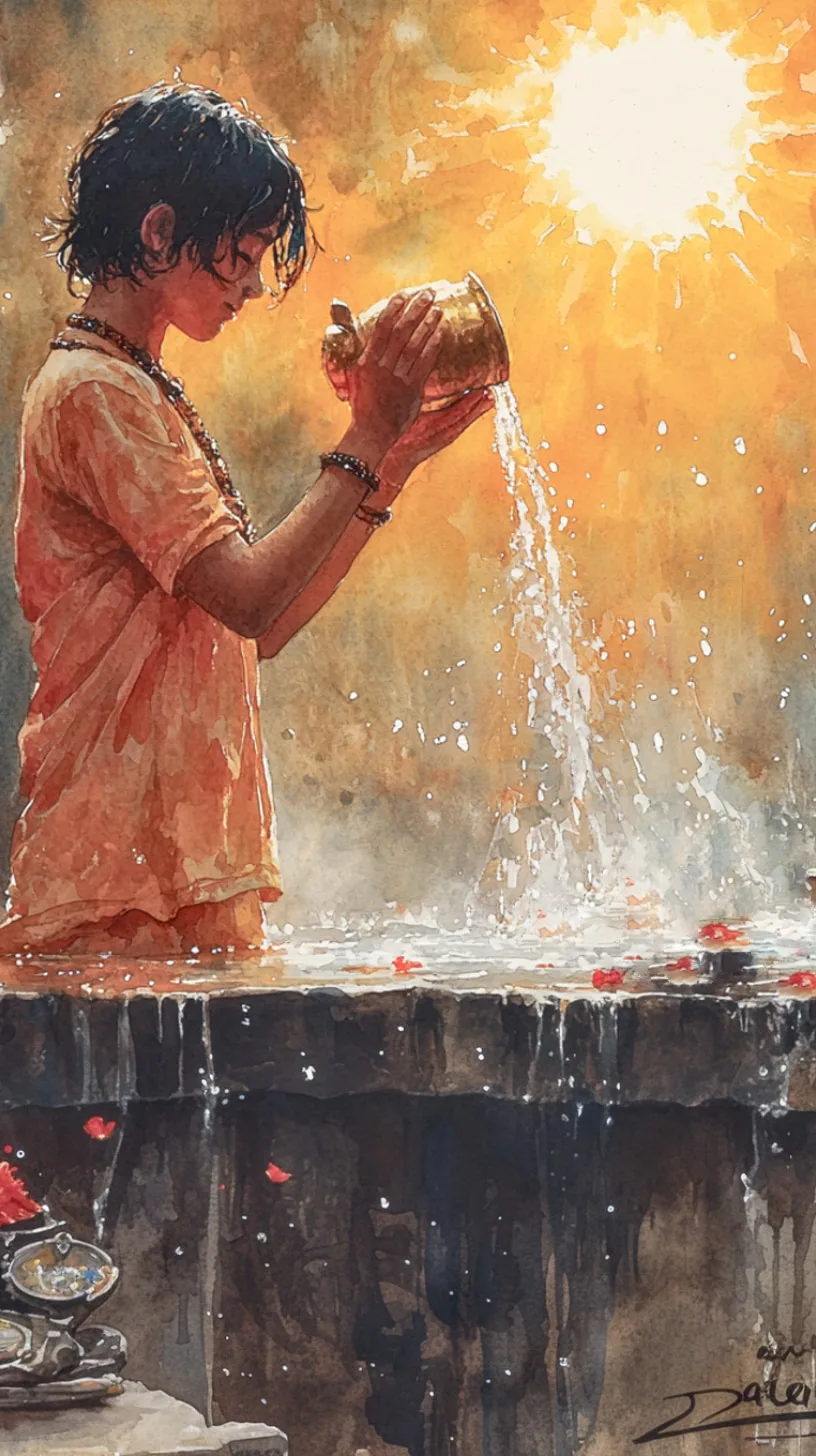
She demonstrated, pouring water in a thin stream while facing the rising sun. As the water fell, it caught the light, creating tiny rainbows.
“Your turn,” she said to Tarkik and Aindri.
Tarkik took the vessel, feeling its cool weight. As he poured, trying to copy Dadi’s graceful movement, he noticed something odd. The water seemed to sparkle more than it should, and where it hit the ground, the earth darkened in perfect circles.
“Three times,” Dadi instructed. “For the three realms – earth, atmosphere, and heaven. Bhur, bhuvah, svah.”
Those words again. From the mantra. Tarkik filed this away, his mind creating categories: mysterious numbers (24, 108, 3), repeated words (bhur bhuvah svah), specific colours (yellow, white), precise timing (dawn).
As they completed the rituals, neighbours began arriving—the courtyard filled with people, all dressed in yellow and white, all carrying flowers and offerings. The individual family observance of Gayatri Jayanti was becoming a community celebration.
“Namaste, Doctor Sahib,” an elderly man greeted Dadi. “The physicist joins us for Gayatri Jayanti again!”
Doctor? Physicist? Tarkik stared at his grandmother, who simply smiled and pressed her palms together in greeting.
“Every year, your grandmother explains more about the connections,” the man continued. “Last year’s talk about the sun’s frequencies was fascinating!”
Frequencies? The sun? Tarkik’s mind raced, but before he could ask, Dadi was gliding away, greeting more arrivals, leaving him with more questions than ever.
As the morning progressed, Tarkik found himself participating in rituals he didn’t understand, surrounded by symbols he couldn’t decode, feeling emotions he couldn’t explain. The sceptical part of his mind noted everything – the precision of the timing, the specific materials used, the exact number of repetitions. But another part of him, a part he rarely acknowledged, felt something else.
When the morning rays fully illuminated the courtyard, when the collective chanting of the now-large gathering reached its peak, when the havan fire burned brightest, Tarkik felt it – a connection to something larger. Not understanding it, not able to explain it, but feeling it nonetheless.
“How do you feel?” Aindri asked during a quiet moment.
Tarkik considered lying, making a joke. Instead, he found himself saying, “Like I’m part of something ancient. Something important. But I don’t know what or why.”
Aindri smiled. “That’s exactly how Gayatri Jayanti is supposed to feel. The understanding comes later. First, you have to experience the mystery.”
As if on cue, Dadi appeared. “Ready for the afternoon session? We observe three sandhyas today – dawn, noon, and dusk. Each has its special significance.”
Three sessions? More patterns? Tarkik nodded, suddenly eager to experience more, to gather more data, to perhaps begin to understand what he was feeling.
The sun climbed higher, and with it, Tarkik’s curiosity. Gayatri Jayanti was proving to be far more complex – and far more intriguing – than he had ever imagined.
PREVIOUS: The Midnight Departure
NEXT: The Sacred Rituals