

The Astronomy Professor’s Haveli
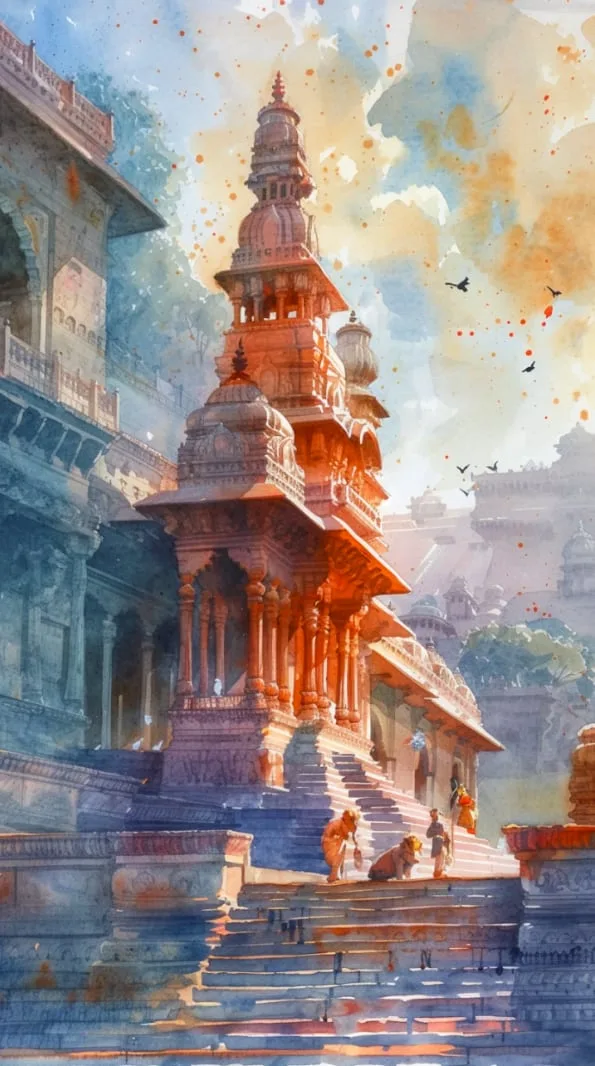
The family haveli stood like a guardian of time in the old part of Haridwar. Its weathered walls held centuries of stories, and its courtyard echoed with the sound of temple bells from nearby ghats. But what caught Tarkik’s attention wasn’t the traditional architecture—it was the modern telescope set up on the terrace.
“Since when do you have a telescope, Dadi?” he asked, immediately drawn to the instrument.
“Since always,” she replied, setting down glasses of fresh nimbu pani. “You think your interest in science came from nowhere? I was tracking asteroids before your father was born.”
“But… but you’re religious!” Tarkik blurted out. “You do puja every morning!”
Dadi’s laughter filled the evening air. “And who told you that science and spirituality are enemies? They’re like the two eyes we need to see the complete picture. Close one, and you lose depth perception.”
Aindri settled cross-legged on the terrace floor. “Dadi, why is Ganga Dussehra so important? I mean, I know the basic story, but why do millions of people come here?”
“Ah,” Dadi said, adjusting her telescope. “First, let me tell you what the faithful believe. Then, perhaps tomorrow, I’ll tell you what this retired astronomy professor has discovered. But tonight, we begin with faith.”
She sat between them, her voice taking on the cadence of ancient storytellers.
“Long, long ago, there lived a king named Sagara. He had sixty thousand sons—”
“Sixty thousand?” Tarkik interrupted. “That’s biologically impossible!”
“Shh,” Aindri elbowed him. “Let her finish.”
Dadi smiled. “Sixty thousand sons who were brave but arrogant. When King Sagara performed the Ashwamedha Yagna, the horse was stolen by Indra and hidden in the ashram of Sage Kapila. The sons, in their arrogance, accused the meditating sage of theft. Kapila, disturbed from his deep meditation, opened his eyes, and his spiritual fire reduced all sixty thousand to ashes.”
The evening sky had darkened, and the first stars began to appear. Somewhere in the distance, the evening aarti bells began to ring.
“Generations passed,” Dadi continued. “King Sagara’s descendant, Anshuman, tried to help his ancestors attain salvation, as did his son Dilip. But it was Dilip’s son, Bhagiratha, who undertook the impossible task. He performed such intense tapasya that Brahma himself appeared.”
“And then?” Aindri leaned forward, even though she knew the story.
“Brahma said only Ganga, who flowed in the heavens, could purify the ashes and grant salvation. But there was a problem—Ganga’s force would destroy the earth. So Bhagiratha performed another penance, this time to Lord Shiva. Moved by his dedication, Shiva agreed to catch Ganga in his matted locks, controlling her flow.”
“The Gangavataran,” Aindri whispered.
“Yes. On this very day—Jyeshtha Shukla Dashami—Ganga descended. Bhagiratha led her across the earth, through mountains and plains, to the ocean where his ancestors’ ashes lay. The moment her waters touched the ashes, sixty thousand souls attained moksha.”
Tarkik had been unusually quiet. Finally, he spoke. “It’s a beautiful story, Dadi. But you don’t actually believe water fell from space, do you?”
Dadi stood up, walking to her telescope. “Come here, both of you. Look at Jupiter.”
They took turns peering through the lens, marvelling at the giant planet and its moons.
“You know,” Dadi said softly, “the ancients called Jupiter ‘Brihaspati’—the guru of the gods. They tracked its movements with remarkable precision. They knew things about the cosmos that we’re only now rediscovering. So when you ask me what I believe…” She paused, smiling enigmatically. “I believe our ancestors were far more sophisticated than we give them credit for. But that’s tomorrow’s conversation. Tonight, we go to the ghat.”
PREVIOUS: The Reluctant Arrival
NEXT: The Sacred Waters