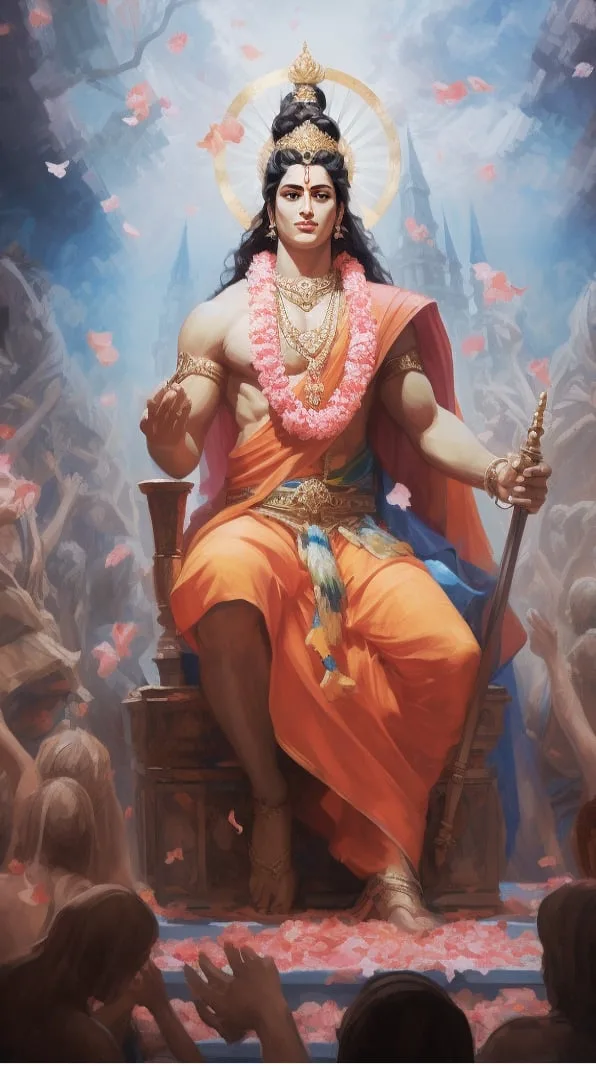


The Return Journey
As their train pulled away from Haridwar station, both teenagers were quiet, processing the profound shift in their understanding.
“I owe you an apology,” Tarkik finally said to Aindri. “I was so arrogant, thinking ancient equals ignorant.”
“And I learned that faith is stronger when it’s informed,” Aindri replied. “Questioning doesn’t weaken belief—it deepens it.”
They watched the Ganga flowing alongside the train tracks, her waters catching the morning sun. The same river that had flowed for millions of years, that had been channelled by ancient engineers, that had been celebrated in story and song, now faced modern threats.
“You know what’s most amazing?” Tarkik said, pulling out his notebook filled with observations. “The festival isn’t just about remembering the past. It’s about understanding the present and protecting the future. Every ritual has environmental wisdom embedded in it.”
“Like what?” Aindri asked.
“The flowers offered must be natural, biodegradable. The lamps are made of leaves or clay, not plastic. Bathing occurs at specific ghats where the current is safe. The dietary restrictions during the festival reduce water usage. It’s all interconnected—spiritual practice and environmental protection.”
Aindri smiled. “So you’ll come back next year?”
“Are you kidding? I have a hundred more questions for Dadi. Like, what astronomical knowledge is encoded in other festivals? What engineering secrets are hidden in temple architecture? What mathematical principles are preserved in ritual geometry?”
“Careful,” Aindri teased. “You’re starting to sound like a believer.”
“Maybe I am,” Tarkik admitted. “Not in blind faith, but in the profound wisdom of our ancestors. They were scientists, engineers, astronomers, and ecologists. They just expressed their knowledge differently.”
PREVIOUS: The Modern Relevance
Author’s Note: This story is based on contemporary research into the scientific knowledge embedded in Indian cultural traditions. The connections between mythology and science presented here reflect scholarly work in archaeoastronomy, ancient engineering, and cultural knowledge systems. As young Tarkik learned, sometimes the most profound truths come wrapped in the most beautiful stories.
The Science Hidden in Ganga Dussehra Stories
Discover how ancient Indian narratives masterfully encoded precise scientific knowledge within beautiful metaphorical language, preserving technical wisdom for generations.
How do ancient Indian stories contain real scientific knowledge?
Sanatan itihaas embeds precise scientific knowledge within rich metaphorical and symbolic language. Stories like Ganga Dussehra work simultaneously as children’s tales, historical memory, technical manuals, and environmental wisdom. This approach makes complex engineering and scientific concepts memorable, transferable, and durable across generations.
What scientific concepts are hidden in “Ganga descending from heaven”?
The “divine descent” metaphor encodes the complete hydrological cycle:
- “Ganga dwelling in heaven” = Water stored as ice/snow in high-altitude Himalayan peaks
- “Descent to earth” = Natural gravitational flow from mountains to plains
- “Lord Brahma’s Kamandal” = The glacial reservoir system
- “Coming from the gods” = Life-giving nature of glacier-fed river systems
This accurately describes how Gangotri Glacier provides water to arid plains even during driest months, with seasonal variations from Himalayan snow melting April-June and monsoon floods July-September.
How does “Shiva catching Ganga in his hair” represent engineering knowledge?
Imagine a massive waterfall crashing down – it would destroy everything below! But what if you could break that force into hundreds of smaller streams? That’s exactly what Shiva’s tangled hair represents.
When water flows through hair-like channels, it loses its destructive power and becomes manageable. Ancient engineers understood this principle perfectly. They created multiple smaller channels, embankments, and terrain features that worked like “hair” – catching the river’s force and releasing it gently.
Modern dam spillways use the same principle! The story captures sophisticated flood control engineering in a simple, memorable image that anyone can understand and remember.
What does “Bhagiratha’s penance” actually represent?
When we hear “years of penance,” we might think of spiritual meditation. But Bhagiratha’s story is actually about the world’s first mega-engineering project!
“Years of penance” means the incredibly long time needed for massive construction work. Historical evidence shows Bhagiratha moved enormous Himalayan boulders and changed the river’s course three times. “Leading Ganga with his chariot” means creating channels and embankments to guide water where people needed it.
The term “Bhagiratha Prayatna” (extraordinary effort) is still used today in India to describe any monumental task requiring years of dedicated work. It’s like ancient India’s equivalent of building the Panama Canal – except they did it thousands of years ago and encoded the engineering knowledge in an unforgettable story!
How does the story preserve geological knowledge?
The narrative preserves memory of landscape formation from 75 million years ago when the Indian subcontinent collided with the Eurasian Plate, creating the Himalayas and Indo-Gangetic Plain. The “bringing down” of divine river parallels actual geological processes that created the river system. “Gods arranging the landscape” represents accurate intuitive understanding of how natural forces shaped geography.
Why is Ganga Dussehra celebrated at a specific time scientifically?
Ganga Dussehra in late May/early June precisely coincides with glacial melt peak and pre-monsoon period. Celebrating “Ganga’s arrival” exactly when natural water flow increases demonstrates sophisticated observation of seasonal hydrology patterns. This timing encodes practical knowledge about when to expect maximum water availability.
How does “ancestral purification” encode multiple layers of meaning?
This extended metaphor works on multiple levels:
- Literal Level: River water has purifying properties
- Scientific Level: Understanding water’s role in agriculture, health, and civilization
- Engineering Level: Need to bring water to specific locations for human settlement
- Symbolic Level: Water as universal cleanser and life-giver
The story follows logical engineering steps: assessment → planning → solution → implementation → success.
Why did ancient Indians use metaphorical language instead of technical manuals?
Imagine trying to teach your grandchildren complex engineering through a 500-page technical manual – they’d fall asleep in minutes! But tell them an exciting story about gods, heroes, and adventures, and they’ll remember every detail for life.
Ancient Indians were brilliant educators. They knew that stories work better than textbooks because they’re:
Memorable: Which is easier to remember – “Shiva caught Ganga in his hair” or “implement multi-channel flow distribution systems for flood control”?
Timeless: Technical manuals become outdated, but stories can preserve core principles for thousands of years.
Universal: A child can enjoy the adventure while an engineer extracts technical knowledge from the same story.
It’s like encoding the iPhone’s blueprint inside a Harry Potter story – future generations could rebuild the technology even if all technical documents were lost!
How is “Ganga as Goddess” scientifically accurate?
When ancient Indians described rivers as goddesses with human personalities, they weren’t being primitive – they were being scientifically accurate!
Think about how rivers actually behave: they can be gentle and life-giving one day, then angry and destructive the next. Just like a person with moods! By giving Ganga human characteristics – proud, powerful, sometimes cooperative, sometimes temperamental – the stories perfectly capture how unpredictable and challenging river management really is.
Calling her Brahma’s “daughter” shows she comes from the sky (water cycle), while Shiva “catching” her represents the relationship between terrain and water flow. Even her “family relationships” in the stories mirror actual scientific relationships in the water cycle.
It’s like giving rivers a personality profile that helps people understand and respect their power – much more effective than just saying “rivers have variable flow patterns”!
What is the modern relevance of this ancient approach?
The story preserves actual engineering knowledge needed for “re-engineering as a perennial river for many millennia to come” and calls for “a new Bhagiratha in our times.” The metaphorical framework continues to provide guidance for modern water management challenges, combining practical wisdom with environmental consciousness that’s desperately needed today.
What makes this “scientific poetry” so sophisticated?
The genius lies in creating narratives where:
- Precise technical knowledge is preserved through vivid metaphorical language
- Engineering principles are encoded in memorable symbolic narratives
- Observational accuracy is embedded in meaningful similes and analogies
- Practical wisdom is transmitted through emotionally resonant stories
You can simultaneously appreciate it as beautiful poetry AND extract precise technical information – depending on your level of understanding and need. This represents perhaps the most sophisticated example of scientific knowledge preservation through literary art.