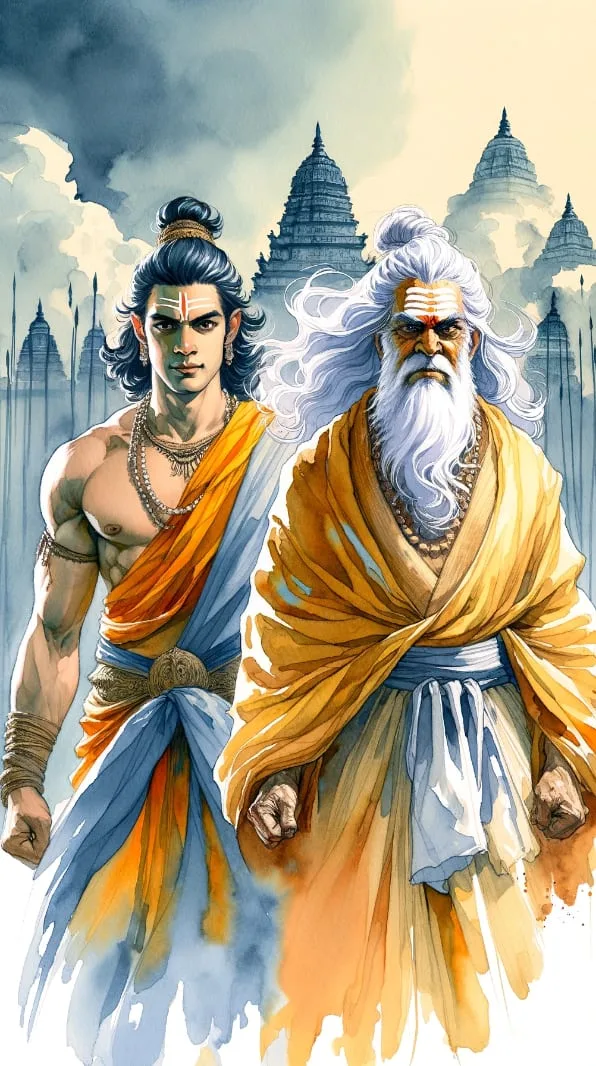
विप्र वंश कै अस प्रभुताई। अभय होई जो तुम्हई डेराई।।
For the reader
In the timeless epic of the Ramayan, a story woven into the very fabric of Indian culture and spirituality, we find ourselves at a pivotal moment just after Lord Ram, an incarnation of the divine Vishnu, has won the hand of Goddess Sita. This extraordinary union was sealed by a feat of unparalleled strength and destiny: the breaking of Lord Shiva’s celestial bow. This act, more than a display of physical prowess, symbolised the unfolding of sacred events that would shape the course of history. What follows is a profound chapter of this saga, where the echoes of Bhagwan Ram’s action ripple through the realms, reaching the ears of another divine being, Parashuram, setting the stage for a meeting of two avatars from different eras, each carrying their legacy and destiny.
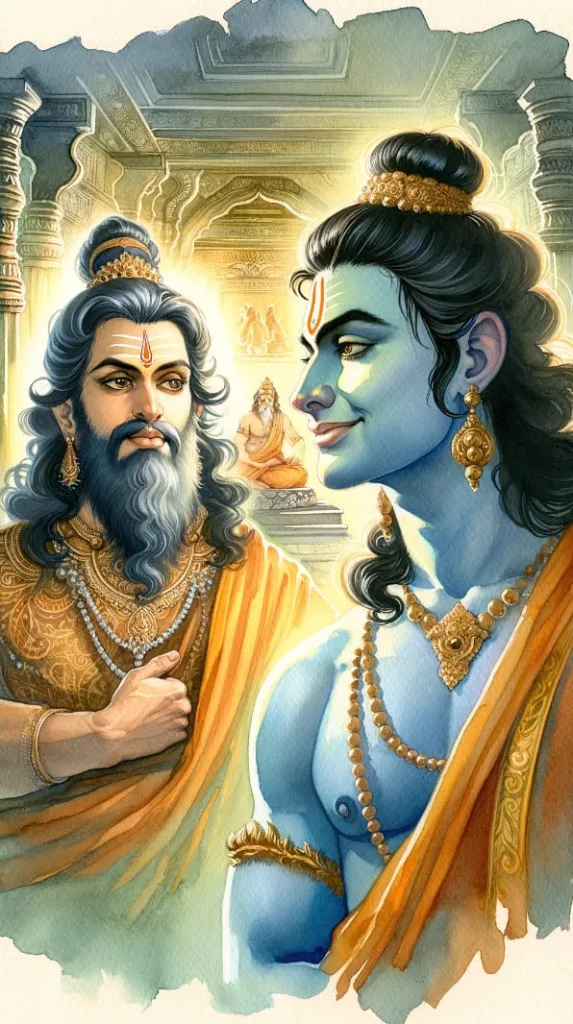
In the splendid chamber of King Janak’s palace, an air of eager expectation filled the room. Princes from different kingdoms had assembled for Princess Sita’s marriage ceremony, where she would choose her husband. Among these princes, Prince Ram of Ayodhya stood out with his calm assurance.
As Ram neared the legendary bow of Lord Shiva, murmurs spread among the onlookers. With a tranquil smile, he caressed the bow and gently said, “May this effort honour the divine Lord Shiva.”
The bow broke under Ram’s formidable force, emitting a sound that resonated through the cosmos. This disturbance reached Parashuram, the intense incarnation of Vishnu, interrupting his meditation. Enraged, he bellowed, “Who dares to disrespect Lord Shiva in this way?”
Upon reaching the court, Parashuram’s anger was like a fierce storm. “Step forward, the brazen one who dared break Lord Shiva’s bow!” he demanded.
Lakshman, bold and steadfast, responded, “Esteemed sage, it’s destiny, not arrogance. My brother, Rama, has fulfilled what was destined.”
Parashuram fixed his intense gaze on Ram. “Is it so, Prince of Ayodhya? Were you the one to break my lord’s bow?”
Ram, ever composed, answered, “Honourable sage, I intended no insult. It was a part of the ceremony, and I acted accordingly.”
Parashuram, growing even more furious, exclaimed, “You have dishonoured Lord Shiva, and I cannot forgive this,” as he brandished his weapons.
Ram, with unwavering calm, stated, “O revered Brahmin deity, as Kshatriyas of the Raghu dynasty, we are bound by our duty, fearless even in the face of death.”
He continued, “Our Raghuvanshi heritage grants us natural bravery. But you, esteemed sage, are not only naturally brave but also distinguished by your authority. Your mere presence instils fearlessness.”
Parashuram listened intently.
Rama added, “O Brahmin deity! We possess the solitary virtue of the bow & arrow, symbolising the Kshatriya. But you embody nine virtues – tranquility (शम), self-control (दम), penance (तप), purity (शौच), forgiveness (क्षमा), simplicity (सरलता), wisdom (ज्ञान), sensory restraint (इन्द्रिय निग्रह), and devoutness (आस्तिकता).”
This realisation brought a wave of calm over Parashuram, softening his anger into understanding.
Ram further explained, “O descendant of Bhrigu! The magnificence of your Brahmin lineage lies in instilling fearlessness through reverence.”
विप्र वंश कै अस प्रभुताई। अभय होई जो तुम्हई डेराई।।
As Rama spoke these lines, Parashuram recognised that he was no ordinary mortal but an incarnation of Lord Vishnu. Still, to dispel any remaining doubt among the audience, he challenged Rama, “If you are truly worthy, then string my bow and prepare an arrow.”
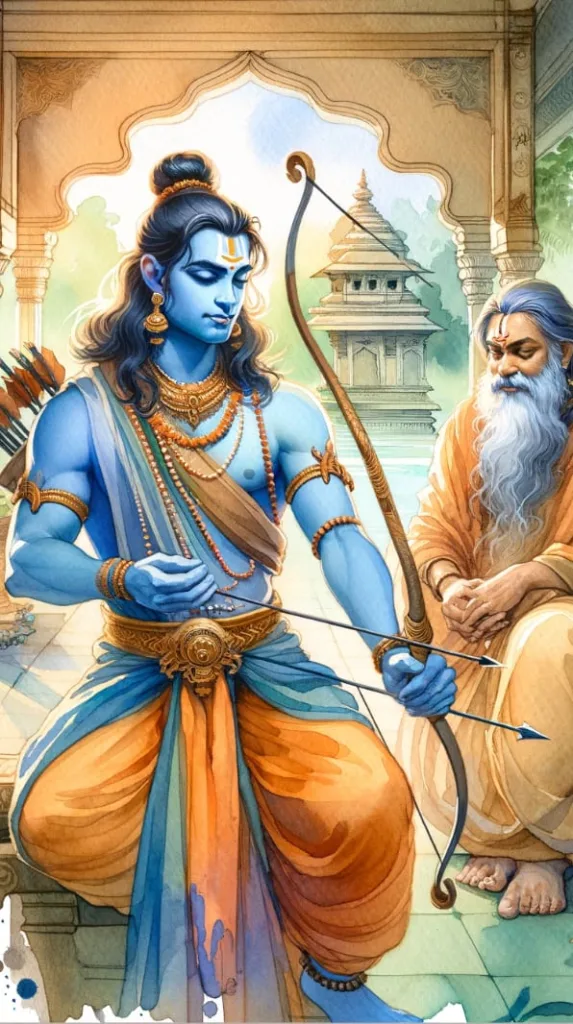
Ram respectfully took the bow, effortlessly strung it, and positioned an arrow. Looking into Parashuram’s eyes, he said, “Venerable sage, your courage and devotion are recognised. Let this arrow symbolise my respect for you.”
Parashuram, moved by Rama’s humility and might, accepted the truth. “You are indeed Vishnu’s avatar, as am I. Rama, use this arrow to conclude my era, sending it eastward to dissolve my virtues and, thus, my ego and anger.”
Parashuram concluded, “Now, it’s your era to prosper.”
Ram lowered the bow, replying, “Your time of strength and austerity will be honoured. I will continue the dharma you have upheld.”
Thus, in this encounter of two divine beings, modesty and wisdom prevailed. The tale of Ram and Parashuram became an everlasting legend, imparting lessons of respect, duty, and the renunciation of ego, even among the greatest of warriors.