Previously: In Chapter IV, Dadi visited Himshikhar Boarding School and answered Tarkik’s question about karma — explaining nishkama karma through King Janaka, Tuladhara the merchant, and the chariot of the Kathopanishad. Tarkik wrote his next question before she left: if nishkama karma means acting without desire for personal gain — and if the only way to truly do that is to have no self whose gain you are protecting — then is the practice of nishkama karma itself the practice of understanding what the Self actually is?
— — —
The notice had gone up on the board outside the staffroom on a Monday: Heritage and Culture Studies — Varanasi Field Trip, Class IX-X, 14–16 November. Compulsory attendance. Permission slips by Friday.
Tarkik had read it, gone back to his room, and sent Dadi a message.
School trip to Varanasi next month. Three days. Are you anywhere nearby?
Her reply came that evening: I will be in Varanasi. There is an astronomy conference at BHU. Find me at Assi Ghat on the morning of the 15th. Come early — before the group activities begin.
He showed it to Aindri. She read it once.
“She was already going to be there,” Aindri said.
“Apparently.”
“Do you think she knew about the trip?”
Tarkik thought about this more than was probably useful. “I don’t know how she would have.”
“And yet.” Aindri handed the phone back. “Early morning. Before group activities. She’s very specific.”
“She’s always specific.”
Aindri nodded slowly. “I’m coming.”
— — —
The school trip arrived in Varanasi on the evening of the 14th — forty-three students, two teachers, a hired bus, and a schedule that included Sarnath, the Vishvanath temple, a classical music demonstration, and a boat ride at sunrise. Mr. Tripathi from the History department had been planning it for three months and was extremely invested in everyone staying together.
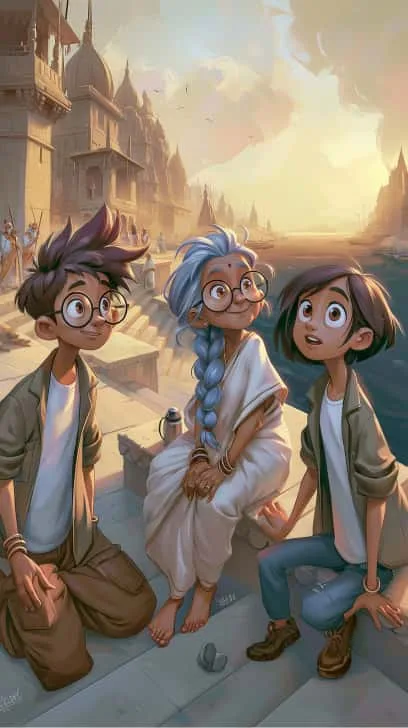
Tarkik and Aindri were at Assi Ghat by six in the morning, a full hour before the group’s first scheduled activity.
The Ganga at dawn in Varanasi was something that had to be seen to be believed, and even then it was hard to believe.
Every ghat was alive — priests doing puja on the stone steps, pilgrims wading in up to their waists with their hands folded and their faces turned toward the rising sun, boats carrying the early visitors out onto the water. The light came in at a low angle from across the river, catching the smoke from the small fires, turning everything amber and gold and grey all at once.
Dadi was already there — sitting on a wide stone step near the southern end of the ghat, a small thermos beside her, looking entirely at home in a city she had clearly visited many times before. She looked up when she heard them on the steps.
“You’re early,” she said.
“You said early,” Tarkik said.
“I did.” She poured chai from the thermos into two small steel cups and held them out. “Sit. We have an hour before your Mr. Tripathi starts counting heads.”
Tarkik touched her feet. Aindri did the same.
“Your question,” Dadi said, settling herself. “From the notebook.”

“Is the practice of nishkama karma itself the practice of understanding what the Self is,” Tarkik said. He had it memorised.
“Yes.” She looked at the river. “And the answer is yes. But to understand why, you need to understand something that comes before nishkama karma. Something older.”
“What?”
“The Law of Sacrifice,” she said. “Which is also the Law of Life.”
— — —
“Before we begin,” she said, “tell me what sacrifice means to you.”
Tarkik thought. “Giving something up. Losing something for the sake of something else.”
“The loss is the part you notice,” Dadi said. “But that is not the definition. Sacrifice means the pouring out of life for the benefit of others. Not loss — giving. Deliberately. The difference matters.”
She let that settle, then: “The first sacrifice — the one on which everything else is based — was not made by a Rishi or a king or a warrior. It was made by Ishvara.”
Aindri looked up.
“Ishvara,” Dadi said, “is pure, unlimited, formless. Brahman in its active aspect — vast, unconstrained. And yet — Ishvara chose to limit Himself. To confine Himself inside matter. To pour Himself into form, so that the Jivas could come into being and begin their journey.” She paused. “The Purusha Sukta of the Rigveda describes this. Purusha — the cosmic being — is the sacrifice. The universe is what is produced from that sacrifice. Creation itself is the act of giving.”
“Ishvara gave up His unlimited nature,” Aindri said slowly, “in order to become the universe.”
“In order to become us,” Dadi said. “So that the Jivas — which are portions of Himself — could develop His own powers inside matter and find their way back. The whole of creation is Ishvara’s gift. Not made from outside — made from Himself.”
Tarkik was very still. On the river, a boat was moving slowly through the amber light, the boatman’s oar making quiet circles.
“This is why,” Dadi continued, “the Gita says that every action performed as a sacrifice — offered to Ishvara, without holding onto the result — becomes part of the same current that has been flowing since the beginning of creation. You are not doing something new. You are joining something that was already under way.”
— — —
“Now,” Dadi said. “The Law of Sacrifice does not begin with human beings making conscious choices. It begins much earlier.”
She gestured at the river.
“The mineral kingdom — the rocks, the soil, the stone of these very ghats — is broken down. Ground to dust. Dissolved into the river. That dissolution feeds the plants that grow on the banks. The plants are eaten by animals. The animals die and their bodies go back into the earth. Every kingdom feeds the one above it.” She paused. “This is not cruelty. It is the mechanism. Every Jiva, at every stage of evolution, is required to give up its current form in order to move to the next one. The form is sacrificed so the Jiva inside can grow.”
“Even without knowing it,” Tarkik said.
“In the early kingdoms — yes. Involuntary. The mineral does not choose to become soil. The plant does not choose to be eaten. The sacrifice happens to them.” She looked at him. “But at the human stage, something changes. For the first time, the Jiva can recognise the law it has been living under. And — for the first time — it can choose to participate in it consciously.”
“Nishkama karma,” Aindri said. “That’s what that is. Consciously joining the sacrifice.”
“You are ahead of the story,” Dadi said, with the small private smile. “But yes.”
— — —
“There is a story I want to tell you,” Dadi said. “From the Mahabharata.”
The ghats were louder now — more pilgrims, more boats, the city fully awake. But in their corner of the step the story created its own quiet.
“The gods were in trouble. Indra, king of the Devas, had committed an unrighteous act — insulted a great Rishi. From that act, through the power of the Rishi’s anger, an Asura was born. Vrittra. Terrible, unstoppable. He drove Indra and all the Devas from their home, took their sovereignty, scattered them into exile.”
Tarkik had his notebook open, pen resting on the page.
“The Devas tried everything. Battle after battle — they could not win. Finally they were told that the Rishi’s righteous anger could only be answered by an act of equal righteousness. And that Vrittra could only be destroyed by one weapon — a thunderbolt made from the bones of a Rishi who gave them willingly.”
“Willingly,” Aindri said.
“This was not a weapon that could be taken. It had to be given.” Dadi’s voice was quiet. “The Devas went to a Rishi named Dadhichi. A man of extraordinary tapas — decades of austerity, his body purified by years of practice until it blazed with spiritual power. They told him what they needed.”

A pause.
“He said yes immediately.”
Tarkik looked up.
“The artificer of the gods, Vishvakarma, came to take the bones — and hesitated. He could not bring himself to cause pain to this shining, purified body. Dadhichi looked at him and smiled. He said: cover this body with salt. Bring a herd of cows. They will lick off the salt and the flesh together. Take only the bones you need. Nothing will be wasted.” She paused. “And this was done. And from Dadhichi’s bones, the thunderbolt was made. And Vrittra fell. And the Devas returned to their home.”
The river moved. A temple bell rang somewhere up the lane.
“He just — said yes,” Aindri said. Not a question. Almost to herself.
“Without hesitation. Without bargaining. Without asking what would be given in return.” Dadi looked at her. “Because Dadhichi had understood what the Jiva actually is. He knew that the body was not him — it was the coat, as we said in Haridwar. And if the coat was more useful as a thunderbolt than as a coat, then that is what the coat should become.”
“He didn’t lose anything,” Tarkik said slowly. “Because he had already stopped thinking of the body as his.”
“Yes. This is what the tradition calls the final stage of sacrifice. Not giving up possessions. Not giving up comforts. Giving up the very sense of self-ownership. The Jiva that has arrived here does not experience sacrifice as loss. It experiences it as — the right use of what it has been given.”
— — —
“Walk me through the stages,” Tarkik said. “How does a Jiva actually move from the involuntary sacrifice — the mineral being ground to dust without knowing it — to what Dadhichi did?”
“Slowly,” Dadi said. “Over many lives. And in three recognisable steps.”
She held up one finger.
“The first step is the hardest to take and the easiest to understand. You give something you own — money, food, time, effort — for the benefit of someone else. No immediate return. You just give.” She paused. “Most people resist this at first because it feels like loss. But the teachers show the Jiva — through experience, over many lives — that what goes out comes back. Not always in the form you expect, not always to you directly, but the giving and the returning are connected. The Jiva learns to trust the law.” She looked at Tarkik. “This is why every tradition in the world teaches generosity as the first practice. It is the entry point. It teaches the hand to open.”
“And once the hand has learned to open?” Aindri asked.
“The second step. Now you give not just things, but experiences. The pleasure you could take — you offer instead. The sleep-in you chose not to take because someone needed you. The food you didn’t eat so someone else could. The comfortable path you didn’t choose because the harder one was more useful.” Dadi’s voice was matter-of-fact. “This is more difficult than giving possessions, because possessions are outside you. Enjoyments are inside — they are what the senses want. To offer them requires the Jiva to begin to govern its own desires, rather than be governed by them.”
“The chariot again,” Tarkik said. “Picking up the reins.”
“Exactly. The second stage and the practice of nishkama karma are the same work approached from different directions.” She looked at him. “You are beginning to see how it fits together.”
He was. He wrote it down.
“And the third step,” Dadi said, “is what Dadhichi showed. Not the giving of things. Not the giving of pleasures. The giving of the sense of self.” She let that sit for a moment. “Not the Atma — that cannot be given or taken, it is Brahman. But the Jiva’s belief that there is a separate ‘me’ whose interests are distinct from the whole. That belief — that constant, effortful maintenance of the boundary between myself and everything else — is what the third stage asks you to put down.”
Aindri said quietly: “And when you put it down — you’re not less. You’re more.”
“When Dadhichi gave his bones, he did not become nothing. He became a thunderbolt that saved the universe.” Dadi looked at her. “The Jiva that has stopped protecting itself has unlimited energy available for everything else. This is not a philosophy. It is a description of what actually happens.”
“And then?” Tarkik asked. “After the third stage?”
“Then every action becomes an offering. Not performed for the actor’s benefit — performed because it is the right action, in this moment, for these people. Exactly as Ishvara acts.” She looked at him steadily. “Your question from the notebook — is nishkama karma the practice of understanding what the Self is? Yes. Because when you act without self-interest, you are already living from the Atma rather than from the Jiva. You are already on the other side of the forgetting.”
— — —
Tarkik wrote for a long time without speaking.
The sun was fully up now. The ghats were gold and white and shadow. Below them the Ganga moved, wide and dark and unhurried, carrying everything it had been given without holding onto any of it.
“That’s what the river is doing,” Aindri said quietly. “All the time. It takes everything — the prayers, the ashes, the flowers, the filth — and it gives it all back to the sea. It doesn’t keep anything.”
“The Ganga,” Dadi said, “has been a teacher in this city for a very long time.”
— — —
They stayed on the ghats until the morning crowds had thinned and Tarkik’s phone showed 7:40 — twenty minutes before Mr. Tripathi’s first headcount. Dadi stood, brushed the stone dust from her saree, and walked with them partway up through the lanes.
The narrow streets of Varanasi closed around them — silk shops and chai stalls and temples that appeared without warning around every corner, their bells ringing at intervals, the smell of incense and flower offerings layered into the stone of the walls as if it had been there since before the city had a name.
“The law of sacrifice,” Dadi said, as they walked, “is also, in the end, the law of liberation. When every action is offered — when nothing is held back for the self — then actions no longer bind. There is no desire behind the action, so no new karma is made. And slowly, the Jiva returns to what it was before the first forgetting.”
“To Brahman,” Tarkik said.
“Through Ishvara. The way a river returns to the ocean — not by stopping, but by flowing completely, without obstruction, all the way to the end.”
They came out onto a small terrace above one of the lanes where the city opened up — rooftops, temple spires, and the curve of the Ganga below catching the mid-morning light, the far bank empty and golden.
Dadi stopped here. “Go. Your Mr. Tripathi will be nervous.”
Tarkik touched her feet. So did Aindri.
“Write the next question,” Dadi said.
He already had it. He waited until she had turned back into the lane, then opened the notebook and wrote:

If the law of sacrifice runs through all of creation — and if Ishvara sacrificed Himself to create the Jivas — then what is the Jiva’s relationship to the Devas, the Rishis, the ancestors, the animals? Are they all part of one system of mutual giving? And what does that say about how the Jiva is supposed to live in relation to everything around it?
He looked at what he had written. It was, he realised, not one question. It was several. He would need to sort them before Haridwar.
Aindri read it over his shoulder. “That’s more than one question.”
“I know.”
“Chapter Six?”
“Probably.” He closed the notebook. “Maybe Chapter Seven.”
Below them, Varanasi went about its ancient business — the oldest living city in the world, still doing what it had always done, still showing anyone who was paying attention exactly how the river reaches the sea.
— — —
Next: Chapter VI — The Jiva’s debts. The tradition speaks of five great debts every human being is born with — to the Devas, the Rishis, the ancestors, other humans, and all living beings. What does it mean to live in a way that honours all of them?